
Clearing in a Wooded Landscape
1676–1730
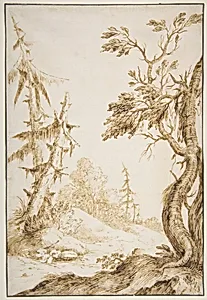
Medium
Pen and brown ink, over traces of graphite or lead; framing lines in pen and dark brown ink
Dimensions
11 1/2 x 7 13/16in. (29.2 x 19.8cm)
Classification
Drawings
Department
Drawings and Prints
Museum
Metropolitan Museum of Art, New York, NY
Credit
Rogers Fund, 1969
Accession Number
69.126.2
Rights
Public Domain
Tags
Art Historical Context
Marco Ricci (1676–0), a Venetian painter draughtsman, masterfully captured the tranquil beauty of nature in *Clearing in a Wooded*, a delicate drawing from the early 18th century. for his atmospheric landscapes and *vedute*—topographical views influenced by the rising interest in the natural world during the late Baroque period—Ricci often blended real observation with imaginative elements. This intimate sheet, measuring just 11½ × 7⅞ inches, depicts a sun-dappled clearing ringed by dense trees, evoking a sense of peaceful retreat amid the wilderness. Executed in pen and brown ink over faint traces of graphite or lead, with precise framing lines, the work showcases Ricci's skillful use of line to suggest depth, texture, and light filtering through foliage. Such drawings were prized in Ricci's time as both preparatory studies for paintings and standalone artistic expressions, highlighting the technical virtuosity of ink on paper. The hatched strokes and fluid contours create a rhythmic interplay of shadow and openness, reflecting the era's fascination with *capriccio* landscapes that idealized nature. Acquired through the Rogers Fund in 1969 and now housed in the Metropolitan Museum of Art's Department of Drawings and Prints, this piece invites visitors to appreciate the subtlety of Ricci's draftsmanship—a window into 18th-century Italy's evolving appreciation for the sublime in everyday scenery.
About the Artist
Marco Ricci · 1676–1730
Marco Ricci (1676–1730) was born on June 6 in Belluno, in the Republic of Venice, into a family steeped in artistic tradition as the nephew of the renowned Baroque painter Sebastiano Ricci. He received his first instruction in art from his uncle, likely during a period in Milan from 1694 to 1696, before accompanying Sebastiano to Venice in 1696, from which he soon fled amid personal troubles. Ricc...