
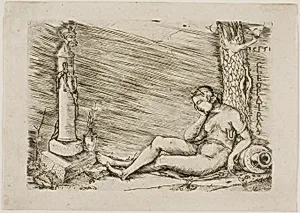
Cleopatra Lying at the Foot of a Tree, with a Term
1515
Medium
Engraving on ivory laid paper
Dimensions
Plate: 10.2 × 14.7 cm (4 1/16 × 5 13/16 in.); Sheet: 12.5 × 17.6 cm (4 15/16 × 6 15/16 in.)
Classification
engraving
Department
Prints and Drawings
Museum
Art Institute of Chicago
Accession Number
76092
Rights
Public Domain
About this artwork
Cleopatra VII (69–30 B.C.), a celebrated female Egyptian pharaoh, solidified her throne through liaisons with Roman leaders, including Julius Caesar and later Mark Antony. Despite her political acumen and wily manipulation of the men in her wake, she is best remembered for her death, which was purportedly a self-inflicted asp bite. Both this print and Jacopo de’ Barbari’s Cleopatra (1945.59) show her either considering snake-assisted suicide or waiting for the poison to take hold.
Art Historical Context
In the early 16th century, enigmatic Master of 1515 this delicate engraving, *Cleopatra Lying at Foot of a Tree, a Term*, exemplifying the Northern Renaissance's fascination with classical antiquity. Dated 1515, the work captures the Egyptian queen in a contemplative pose at the base of a tree accompanied by a term—a classical sculptural pillar topped with a bust—evoking themes of beauty, power, and tragic downfall. This anonymous artist, identified by a dated print from the same year, specialized in intricate small-scale engravings that brought mythological narratives to a wider audience beyond elite paintings. Printed on luxurious ivory laid paper, the plate measures just 10.2 × 14.7 cm, inviting intimate study. Engraving's precise intaglio technique allowed for fine lines and rich tonal contrasts, making it a pivotal medium for disseminating Renaissance humanism. Cleopatra, a symbol of seductive sovereignty and suicide by asp, resonated in an era rediscovering Roman texts, blending eroticism with moral allegory. Housed in the Art Institute of Chicago's Prints and Drawings Department, this rare survival highlights printmaking's role in democratizing art, bridging ancient lore with early modern sensibilities. Visitors will appreciate its technical finesse and timeless allure.