
Clock ornament
Unknown Artist
18th century
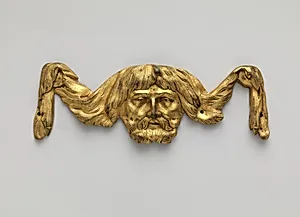
Medium
Gilt bronze
Dimensions
Overall (confirmed): 2 1/8 × 6 1/8 × 3/8 in. (5.4 × 15.6 × 1 cm)
Classification
Metalwork-Gilt Bronze
Culture
French
Department
European Sculpture and Decorative Arts
Museum
Metropolitan Museum of Art, New York, NY
Credit
Gift of J. Pierpont Morgan, 1906
Accession Number
07.225.510.193
Rights
Public Domain
Tags
Art Historical Context
This delicate *Clock Ornament*, crafted in 18th-century France by an unknown artist, exemplifies the opulent metalwork of the European decorative arts. Fashioned from gilt bronze—a luxurious technique where a thin layer of gold is applied over bronze for a radiant, enduring shine—this small piece measures just 2 1/8 × 6 1/8 × 3/8 inches. Its slender profile suggests it adorned the face or frame of a grand mantel clock, enhancing the timepiece's elegance in lavish salons of the French aristocracy. Gilt bronze reached its zenith during the Rococo and early Neoclassical periods, blending intricate chasing, engraving, and mercury gilding to create shimmering surfaces that caught the flicker of candlelight. The ornament's tag noting "faces" hints at finely modeled human or allegorical visages, common motifs symbolizing time's passage or the muses of the clockmaker's art. Such pieces were prized for their technical virtuosity and role in furnishing the homes of the elite, reflecting France's dominance in luxury goods export. A generous gift from financier J. Pierpont Morgan in 1906, this treasure now graces the Metropolitan Museum of Art's Department of European Sculpture and Decorative Arts. It invites us to appreciate the artistry hidden in everyday opulence, bridging the mechanical precision of clocks with the poetic flourish of 18th-century design.