
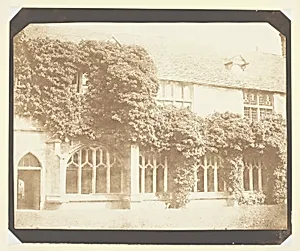
Cloisters of Lacock Abbey
c. 1841/44
Medium
Salted paper print
Dimensions
Image: 16.2 × 21.5 cm (6 7/16 × 8 1/2 in.); Paper: 18.7 × 22.4 cm (7 3/8 × 8 7/8 in.)
Classification
salted paper print
Department
Photography and Media
Museum
Art Institute of Chicago
Accession Number
39015
Rights
Public Domain
Art Historical Context
Step into the hushed stone arches of *Cloisters of Lac Abbey*, a pioneering salted paper print by William Henry Fox Talbot, created around 1841–44. Talbot, a British inventor and scholar, captured the Gothic tranquility of his ancestral home in Wiltshire, England, using one of the earliest photographic processes. This image marks a pivotal moment in the 1840s "paper wars" of photography, as Talbot raced against Louis Daguerre to claim invention rights, showcasing his innovative calotype method. The salted paper print—a delicate positive made by brushing paper with salt, sensitizing it with silver nitrate, and exposing it to light—reveals intricate details like weathered stone and subtle shadows. Unlike Daguerre's unique metal plates, Talbot's negative-positive system allowed multiple prints from a single exposure, democratizing image reproduction and laying groundwork for modern photography. Housed in the Art Institute of Chicago's Photography and Media department, this 16.2 × 21.5 cm gem (on slightly larger paper) embodies the artistic shift from drawing to "drawing with light" (photography's Greek roots). It invites us to marvel at how Talbot transformed sunlight into history, forever changing how we document the world.
About the Artist
William Henry Fox Talbot · 1800–1877
William Henry Fox Talbot (1800–1877), a British polymath whose ingenuity transformed visual representation, was born on 11 February 1800 at Melbury House, Dorset, the only child of William Davenport Talbot of Lacock Abbey and Lady Elisabeth Fox Strangways, daughter of the 2nd Earl of Ilchester. His father died shortly after his birth, leaving the family in financial straits until his formidable mo...