
Close Helmet
Unknown Artist
ca. 1850 in the style of the mid-16th centuru
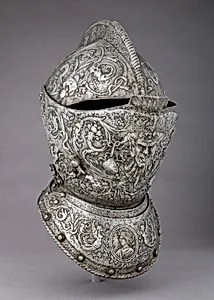
Medium
Steel, brass
Dimensions
H. 15 1/2 in. (39.4 cm); W. 8 5/16 in. (21.1 cm); D. 12 1/2 in. (31.8 cm); Wt. 5 lb. 8 oz. (2500 g)
Classification
Helmets
Culture
French
Department
Arms and Armor
Museum
Metropolitan Museum of Art, New York, NY
Credit
Gift of William H. Riggs, 1913
Accession Number
14.25.611
Rights
Public Domain
Art Historical Context
This elegant close helmet, crafted around 1850 in the style of mid-16th-century French, exemplifies the 19th-century fascination with medieval revivalism. Produced by an unknown artisan, it belongs to the Arms and Armor at The Metropolitan Museum of Art, gifted by William H. Riggs in 1913. Measuring 15½ inches high and weighing a substantial 5 pounds 8, its steel construction with brass accents provided full head protection for Renaissance warriors, featuring a pivoting visor that sealed the face for combat. Close helmets like this one emerged in the early 16th century as plate armor evolved, offering superior defense against thrusting weapons and firearms while allowing restricted vision and breath. Though made nearly 300 years later, this piece reflects Romantic-era nostalgia, when collectors and craftsmen romanticized chivalric pasts amid industrialization. French in origin, it highlights the enduring prestige of Milanese and Burgundian armor traditions adapted for elite display. Today, it invites us to ponder the blend of utility and artistry in protective gear—forged steel hammered to a smooth finish, brass for durable joints—bridging history's battlefields with modern admiration. (198 words)