
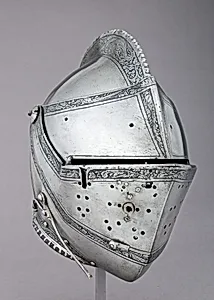
Close Helmet for the Tourney
dated 1552
Medium
Steel, leather, brass
Dimensions
H. 10 1/2 in. (26.7 cm); W. 8 5/16 in. (21.1 cm); D. 12 1/4 in. (31.1 cm); Wt. 6 lb. 3 oz. (2797 g)
Classification
Helmets
Culture
Austrian, Innsbruck
Department
Arms and Armor
Museum
Metropolitan Museum of Art, New York, NY
Credit
Bashford Dean Memorial Collection, Gift of Edward S. Harkness, 1929
Accession Number
29.156.47
Rights
Public Domain
Art Historical Context
Step into the clangor of Renaissance Europe with this exquisite *Close Helmet for the Tourney*, crafted in 1552 by Daniel Hop, a master from Innsbruck, Austria—a city renowned as a cradle of fine armor-making during the 16th century. This steel helmet, bolstered by leather padding and brass accents, was designed for the high-stakes world of tourneys, or jousting tournaments, where knights charged at full gallop. Fully enclosing the wearer's head for maximum protection, its compact dimensions (H. 10½ in., W. 8⅜ in., D. 12¼ in., weighing just over 6 pounds) balanced mobility with unyielding defense, essential for the chivalric spectacles that blended sport, pageantry, and martial prowess. Hopfer's work exemplifies the artistic pinnacle of arms and armor, where functionality fused with Renaissance aesthetics. Innsbruck armorsmiths like him often employed etching techniques—Hopfer himself pioneered etched metalwork—to adorn surfaces with intricate motifs, though this helmet's surface speaks to the era's emphasis on polished steel and precise forging. Part of the Metropolitan Museum of Art's Bashford Dean Memorial Collection, gifted in 1929, it highlights how such pieces were status symbols for nobility, embodying the cultural zenith of Habsburg-era tournaments before firearms reshaped warfare. Today, this helmet invites us to ponder the artistry in armor: not mere protection, but a sculpted testament to human ingenuity and the thrill of the joust.
About the Artist
Daniel Hopfer · 1471–1536
Daniel Hopfer (c. 1470–1536), born in Kaufbeuren, was the son of the painter Bartholomäus Hopfer and Anna Sendlerin. He relocated early to Augsburg, becoming a citizen and master painter there in 1493, and trained as an etcher of armor in this thriving center of arms production. By 1505, he owned a house in the city center and served on the guild committee for smiths, which encompassed painters an...