
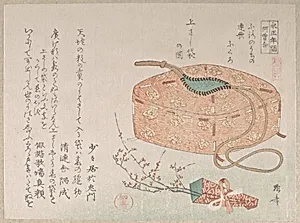
Cloth Bag with Cords and Plum Blossoms
19th century
Medium
Part of an album of woodblock prints (surimono); ink and color on paper
Dimensions
5 1/2 x 7 5/16 in. (14 x 18.6 cm)
Classification
Prints
Culture & Period
Japan · Edo period (1615–1868)
Department
Asian Art
Museum
Metropolitan Museum of Art, New York, NY
Credit
H. O. Havemeyer Collection, Bequest of Mrs. H. O. Havemeyer, 1929
Accession Number
JP2252
Rights
Public Domain
Tags
Art Historical Context
**Cloth Bag with Cords Plum Blossoms** Ryūryūkyo Shinsai captures the delicate beauty of everyday objects infused with poetic elegance. Created in the 19th century Japan's Edo period (16151868), this wood print is part of a surimono album—a genre of privately commissioned prints often exchanged as New Year's greetings among literati. Shinsai, a master of ukiyo-e ("pictures of the floating world"), specialized in these intimate works, blending meticulous detail with subtle color gradients in ink and pigment on paper. Measuring just 5½ x 7⅜ inches, its compact size invites close contemplation, much like a treasured fan or scroll. The composition features a cloth bag adorned with knotted cords and blooming plum blossoms, evoking themes of renewal and resilience. Plum blossoms, among the first to flower in late winter, symbolize perseverance in Japanese culture, their fragile petals defying the cold. Surimono like this one often incorporated kyōka poetry (humorous tanka variants), though none is visible here; the focus on natural motifs highlights Shinsai's skill in rendering textures—from the bag's soft folds to the blossoms' velvety petals—using woodblock techniques like bokashi (color shading) for lifelike depth. Housed in the Metropolitan Museum of Art's Asian Art Department from the H.O. Havemeyer Collection, this print exemplifies Edo-era artistry's fusion of utility and refinement, offering visitors a window into Japan's vibrant print culture where beauty bloomed in the humblest forms.
About the Artist
Ryūryūkyo Shinsai · 1799–1823
Ryūryūkyo Shinsai (柳々居辰斎), active from 1799 to 1823, was a prominent Japanese ukiyo-e printmaker based in Edo (modern Tokyo), renowned for his mastery of surimono—luxurious, privately commissioned woodblock prints produced for elite poetry circles and New Year's celebrations. He began his training under Tawaraya Sōri before becoming a student of the legendary Katsushika Hokusai, from whom he recei...