
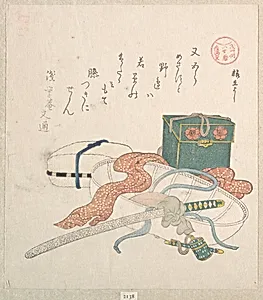
Outfit for Travel
19th century
Medium
Woodblock print (surimono); ink and color on paper
Dimensions
8 5/16 x 7 3/8 in. (21.1 x 18.7 cm)
Classification
Prints
Culture & Period
Japan · Edo period (1615–1868)
Department
Asian Art
Museum
Metropolitan Museum of Art, New York, NY
Credit
H. O. Havemeyer Collection, Bequest of Mrs. H. O. Havemeyer, 1929
Accession Number
JP2138
Rights
Public Domain
Tags
Art Historical Context
Kubo Shunman's *Outfit for Travel*19th century) is a exquisite example of Japanese surimono, a type of woodblock print produced in small, luxurious editions for private patrons, often featuring poetry alongside vivid imagery. Created during the Edo period (161–1868), this work measures just 8 5/16 x 7 3/8 inches, showcasing the artist's mastery of ukiyo-e techniques. Shunman (1777–1845), a versatile poet and printmaker, layered ink and color on paper with precise registration, subtle gradations (bokashi), and possibly embossing or mica for texture, evoking the tactile allure of high-end commissions. The print depicts a traveler's ensemble, complete with swords—a nod to samurai culture and the era's emphasis on status symbols during journeys along Japan's roads. Edo-period travel was both practical and ritualistic, with outfits blending functionality and elegance amid strict sumptuary laws. This piece captures the floating world (ukiyo) of fashion and mobility, reflecting societal fascination with wanderers, pilgrims, and warriors. Housed in the Metropolitan Museum of Art's Asian Art Department as part of the H. O. Havemeyer Collection (1929), it invites us to ponder daily life in old Japan, where art democratized luxury for the elite. A gem for admirers of refined printmaking!
About the Artist
Kubo Shunman · 1757–1820
Japanese, 1757–1820