
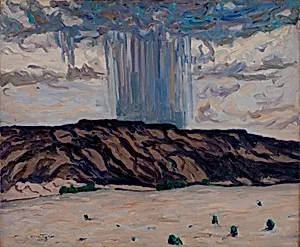
Cloudburst at Black Mesa, New Mexico
1925
Medium
Painting
Classification
Painting
Department
Smithsonian Collection
Museum
Smithsonian American Art Museum
Credit
Smithsonian American Art Museum, Gift of the Allen Tucker Memorial
Accession Number
1966.34.2
Rights
Public Domain
Tags
About this artwork
Allen Tucker was one of the “big city” artists who came to New Mexico in the 1920s, forsaking the hustle and clamor of the city for the vast spaces of the high desert. Artists from New York and Chicago often focused on the unusual colors and shapes they found in the southwestern landscape or on the startling and theatrical effects of the weather. Here, Tucker captured the sudden violence and stark contrasts of light and dark that a New Mexico storm can bring.
Art Historical Context
In 1925, Allen Tucker joined a wave of New York and Chicago artists drawn to New Mexico’s high desert. Leaving behind urban life, these painters discovered a landscape of dramatic scale and unpredictable weather. Tucker’s *Cloudburst at Black Mesa, New Mexico* records one such moment, when a sudden storm sweeps the mesa, throwing sharp contrasts of light and shadow over the desert floor. The painting highlights the theatrical effects that fascinated early-twentieth-century visitors to the Southwest. Dark clouds press against the flat-topped mesa while shafts of sunlight break through, illuminating distant mountains and the vast, open plain. Through these bold contrasts, Tucker conveys both the beauty and the raw power of a desert downpour. As part of the Smithsonian American Art Museum’s collection, the work preserves the experience of artists who helped shape an American vision of the West—not as a romantic frontier, but as a place of striking natural drama.