
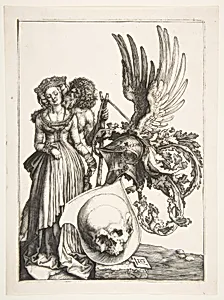
Coat of Arms with a Skull
1503
Medium
Engraving
Dimensions
Plate: 8 11/16 x 6 1/4 in. (22.1 x 15.8 cm) Sheet: 9 9/16 x 7 in. (24.3 x 17.9 cm)
Classification
Prints
Department
Drawings and Prints
Museum
Metropolitan Museum of Art, New York, NY
Credit
Fletcher Fund, 1919
Accession Number
19.73.113
Rights
Public Domain
Tags
Art Historical Context
In the heart of the Northern Renaissance, Albrecht Dür, the masterful German artist and printmaker, created *Coat of Arms with Skull* in 1503. This striking engraving exemplifies Dürer's revolutionary command of the medium, transforming copper plates into intricate works of art rivaling painting. Measuring about 8 11/16 x 6 1/4 inches on the plate, it showcases his signature precision—fine, cross-hatched lines that capture texture, shadow, and depth with breathtaking clarity. Owned by the Metropolitan Museum of Art since 1919 through the Fletcher Fund, it's a gem in their Drawings and Prints collection. The composition blends heraldry with profound symbolism: a central coat of arms flanked by elegant female figures, overshadowed by a prominent skull. This *memento mori* motif, evoking "remember death," was a cultural touchstone in early 16th-century Europe, urging viewers to contemplate life's fleeting nature amid worldly honors. Dürer's women, graceful yet somber, embody vanity's allure, while the skull anchors the scene in inescapable mortality—a poignant reminder in an era of plague and religious upheaval. Dürer's engravings like this democratized high art, making complex ideas accessible through affordable prints. Visitors, gaze closely at the skeletal details; they whisper timeless wisdom, blending beauty with the macabre in true Renaissance fashion.
About the Artist
Albrecht Dürer · 1471–1528
Albrecht Dürer (1471–1528) stands as the preeminent figure of the Northern Renaissance and arguably the most influential artist in the history of printmaking. Born in Nuremberg on May 21, 1471, and dying in the same city on April 6, 1528, Dürer revolutionized the status of the artist in Northern Europe, transforming printmaking from a commercial craft into an independent fine art and establishing ...