
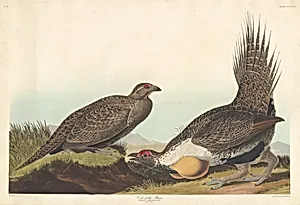
Cock of the Plains
Medium
hand-colored engraving and aquatint on Whatman wove paper
Classification
Department
CG-W
Museum
National Gallery of Art, Washington, D.C.
Credit
Gift of Mrs. Walter B. James
Accession Number
1945.8.371
Rights
Public Domain
Art Historical Context
Step into the vivid world of 19th-century American ornithology with *Cock of the Plains*, stunning hand-colored engraving and aquint created by Robert Havell after John James Audubon in1837. This print part of Audubon's legendary *The Birds of America*, a monumental double-elephant folio series (1827–1838) that captured life-sized depictions of over 400 North American bird species. Audubon, a pioneering naturalist and artist, posed his subjects in dramatic, naturalistic scenes to highlight their habitats and behaviors, revolutionizing scientific illustration with artistic flair. Havell's masterful techniques shine here: fine engraving provides intricate feather details, while aquatint adds soft tonal gradients for depth and realism. Printed on high-quality Whatman wove paper and meticulously hand-colored by a team of studio artists, the result mimics Audubon's original watercolor vibrancy, making the plains-dwelling cock (a greater prairie-chicken) leap off the page in earthy browns and bold patterns. This medium elevated prints from mere reproductions to collectible artworks, blending art, science, and exploration during America's expanding frontier era. Now in the National Gallery of Art's collection—thanks to the generous gift of Mrs. Walter B. James—this piece celebrates biodiversity and the fusion of observation with creativity, inviting visitors to appreciate the wild beauty Audubon fought to preserve.
About the Artist
Robert Havell after John James Audubon
Robert Havell Jr., born on November 25, 1793, in Reading, Berkshire, England, was the son of renowned engraver and publisher Robert Havell Sr. and Lydia Miller Phillips. Growing up in a family of artists that included notable engravers and etchers, he trained under his father, mastering aquatint techniques early on. Though briefly estranged from the family business, Havell reconciled with his fath...