
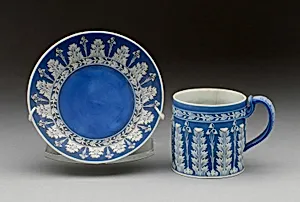
Coffee Can and Saucer
c. 1790
Medium
Stoneware (jasperware)
Dimensions
2.5 × 12.1 cm (1 × 4 3/4 in.); Cup: 7 × 9.2 cm (2 3/4 × 3 5/8 in.); Saucer: H.: 3.2 cm (1 1/4 in.)
Classification
teaware
Department
Applied Arts of Europe
Museum
Art Institute of Chicago
Accession Number
67630
Rights
Public Domain
Art Historical Context
This elegant coffee can and saucer, crafted around 1790 by the Wedgwood Manufactory, exemplifies the refined taste of late eighteenth-century European tableware. Made from stoneware known as jasperware, the set features the material’s signature matte, unglazed surface that allowed for crisp, cameo-like relief decoration. Its modest scale—roughly the size of a modern espresso cup—reflects the period’s growing enthusiasm for coffee as a sophisticated social beverage. Wedgwood’s innovative jasperware technique, developed in the 1770s, combined durable stoneware with classical motifs inspired by ancient cameos and gems. By the 1790s, such teaware had become highly desirable among Britain’s middle and upper classes, blending industrial precision with neoclassical elegance. The Art Institute’s example highlights how everyday rituals of drinking coffee were elevated through thoughtful design and craftsmanship. As part of the Applied Arts of Europe collection, this piece invites visitors to appreciate the intersection of technology, fashion, and daily life in the Age of Enlightenment. Its enduring appeal lies in the way Wedgwood transformed humble utility into quiet luxury.
About the Artist
Wedgwood Manufactory
Wedgwood Manufactory, founded on 1 May 1759 by Josiah Wedgwood in Burslem, Staffordshire, England, revolutionized ceramics during the Industrial Revolution. Born into a family of potters, Josiah apprenticed under his elder brother Thomas at the Churchyard Works from age 14, mastering traditional techniques before partnering with Thomas Whieldon from 1754 to 1759, where he honed innovative glazes. ...