
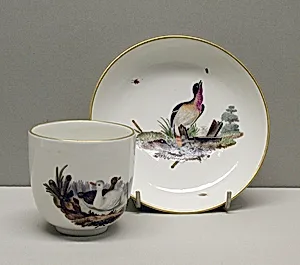
Coffee cup and saucer
ca. 1775
Medium
Hard-paste porcelain
Dimensions
Diameter, saucer: 5 1/8 in. (13 cm) Overall, cup: 2 1/2 x 3 1/2 in. (6.4 x 8.9 cm)
Classification
Ceramics-Porcelain
Culture
German, Höchst
Department
European Sculpture and Decorative Arts
Museum
Metropolitan Museum of Art, New York, NY
Credit
Gift of Mercedes Bass, 2007
Accession Number
2007.243.7a, b
Rights
Public Domain
Tags
Art Historical Context
This delicate coffee cup and saucer crafted by the renowned Höchst Manufactory 1775, exemplifies pinnacle of 18th-century German porcelain. Produced in Höchst, near Frankfurt, the manufactory was a key player in Europe's quest to rival Chinese porcelain, mastering hard-paste porcelain—a durable, translucent material fired at high temperatures that allowed for intricate shapes and vibrant decorations. Measuring a dainty 5 1/8 inches in saucer diameter and 21/2 x 3 1/2 inches for the cup, this set was designed for intimate coffee rituals, a fashionable social pastime among Europe's elite. The piece's artistic significance lies in its technical virtuosity and decorative charm, likely featuring finely painted birds or ducks—a motif evoking nature's whimsy in the rococo style prevalent at Höchst. Hard-paste porcelain enabled jewel-like glazes and precise overglaze enameling, making such wares coveted luxury goods. By the 1770s, as coffee culture flourished, these objects symbolized refinement and cosmopolitan taste, bridging everyday indulgence with high art. Today, gifted to the Metropolitan Museum of Art in 2007, this survivor from Mercedes Bass's collection invites us to savor the era's blend of innovation and elegance, where a simple cup held the world in miniature.