
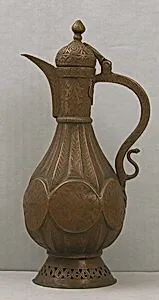
Coffee Pot
Unknown Artist
19th century
Medium
Copper
Dimensions
H. 9 5/8 in. (24.4 cm) W. 4 3/4 in. (12.1 cm) Diam. 3 9/16 in. (9 cm) Wt. 12.9 oz. (365.7 g)
Classification
Metal
Department
Islamic Art
Museum
Metropolitan Museum of Art, New York, NY
Credit
Edward C. Moore Collection, Bequest of Edward C. Moore, 1891
Accession Number
91.1.576
Rights
Public Domain
Art Historical Context
This elegant 19th-century copper pot, standing just under 10 inches tall, the refined metalworking traditions of the Islamic world. Crafted from copper—a material prized for its excellent heat conductivity and malleability—the pot features a slender spout, curved handle, and compact form ideal for brewing and pouring thick, aromatic coffee. Such vessels, often called *ibriks* or *cezves*, were everyday essentials in households and coffeehouses across the Ottoman Empire and beyond, reflecting the artistry of anonymous craftsmen who hammered and shaped the metal with precision. In the 19th century, coffee culture flourished in Islamic societies, where these pots played a central role in rituals of hospitality and social bonding. Coffeehouses became vibrant hubs for conversation, poetry, and even political discourse, underscoring the beverage's cultural significance. The pot's modest dimensions (9 5/8 inches high, weighing about 13 ounces) highlight its portability and functionality, blending utility with subtle aesthetic appeal typical of Islamic metalwork. Acquired through the Edward C. Moore Collection and bequeathed to the Metropolitan Museum of Art in 1891, this piece offers a window into the everyday splendor of Islamic life, inviting visitors to appreciate the harmony of form, function, and tradition.