
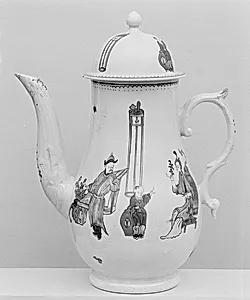
Coffeepot
ca. 1770
Medium
Soft-paste porcelain
Dimensions
Height (with cover): 9 5/8 in. (24.4 cm)
Classification
Ceramics-Porcelain
Culture
British, Liverpool
Department
European Sculpture and Decorative Arts
Museum
Metropolitan Museum of Art, New York, NY
Credit
Gift of Mr. and Mrs. Luke Vincent Lockwood, 1939
Accession Number
39.140.92a, b
Rights
Public Domain
Tags
Art Historical Context
This elegant coffeepot, crafted around 1770 by Philip Christian in Liverpool, England, exemplifies the British porcelain industry's innovative response to the era's booming tea and coffee culture. Produced at one of Liverpool's pioneering soft-paste porcelain factories, it reflects the city's role as a major port and manufacturing hub during the 18th century. Soft-paste porcelain, a glassy, translucent material made from white clay mixed with ground glass or frit, was a crucial European breakthrough before the perfection of true hard-paste from China. Standing at 9 5/8 inches tall with its cover, this piece was designed for genteel domestic use, blending functionality with decorative appeal. The coffeepot's surface likely features lively scenes of boys, men, and women—common motifs in Liverpool porcelain that drew from English daily life, theater, or pastoral themes—often applied via transfer-printing or hand-painting techniques. These methods allowed for affordable, repeatable designs that rivaled expensive imported Chinese wares. As part of the Metropolitan Museum of Art's European Sculpture and Decorative Arts collection (gift of Mr. and Mrs. Luke Vincent Lockwood, 1939), it highlights how such objects democratized luxury, symbolizing middle-class aspirations amid Britain's expanding global trade. A charming survivor of Georgian refinement!