
Coffeepot (part of a tea service)
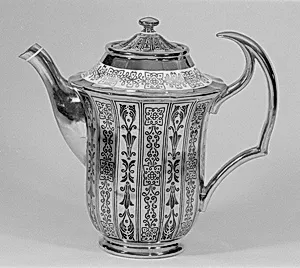
Medium
Hard-paste porcelain
Dimensions
Height (with cover): 6 in. (15.2 cm)
Classification
Ceramics-Porcelain
Culture
Russian, St. Petersburg
Department
European Sculpture and Decorative Arts
Museum
Metropolitan Museum of Art, New York, NY
Credit
Bequest of John Rolston Peacock, 1969
Accession Number
69.162.2a, b
Rights
Public Domain
Art Historical Context
This elegant coffeepot, part of a refined tea service, hails from the Imperial Porcelain Manufactory in St. Petersburg, Russia, crafted in 1834. Established under imperial patronage, the manufactory was a pinnacle of Russian craftsmanship during the reign of Tsar Nicholas I, producing luxury goods for the court and aristocracy. Standing just 6 inches (15.2 cm) tall with its cover, this piece embodies the sophistication of 19th-century European decorative arts, blending functionality with imperial prestige. Made of hard-paste porcelain—a high-fired, vitrified material prized for its strength, translucency, and fine white body—this coffeepot showcases advanced ceramic techniques. Unlike softer varieties, hard-paste allowed for intricate detailing and durability, making it ideal for everyday elite use while rivaling the finest Meissen or Sèvres wares. Its presence in a tea service highlights the ritualistic role of such vessels in Russian social life, where tea and coffee gatherings fostered hospitality and status. Today, housed in the Metropolitan Museum of Art's Department of European Sculpture and Decorative Arts through the 1969 bequest of John Rolston Peacock, this coffeepot invites us to appreciate the artistry of imperial Russia—a delicate survivor of opulent pastimes.
About the Artist
Imperial Porcelain Manufactory, St. Petersburg · 1744–present
The Imperial Porcelain Manufactory in Saint Petersburg, founded in 1744 by Dmitry Ivanovich Vinogradov under the decree of Empress Elizabeth Petrovna, marked Russia's entry into porcelain production as the third such enterprise in Europe after Meissen and Vienna. Vinogradov, a mining engineer educated in Saxony, developed the nation's first hard-paste porcelain formula using local materials, drawi...