
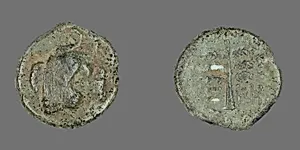
Coin Depicting Pegasus
4th century BCE
Medium
Bronze
Dimensions
Diam.: 1.4 cm (9/16 in.)
Classification
coin
Department
Arts of Greece, Rome, and Byzantium
Museum
Art Institute of Chicago
Accession Number
142787
Rights
Public Domain
Art Historical Context
This tiny bronze coin from 4th century BCE Ancient Greece, measuring just 1.4 cm in diameter, showcases the mythical winged horse Pegasus on its obverse—a symbol of power and divine favor. Struck with remarkable precision for its size, it exemplifies early Greek numismatics, where coins transitioned from simple markings to intricate imagery, serving as both currency and civic emblems. Pegasus, from the blood of Medusa, was closely tied to Corinth, whose mints popularized this motif starting in the 7th century BCE. By the Classical period, such coins circulated widely across the Mediterranean, promoting trade and city-state identity. The reverse likely features an incuse punch or simpler design, a technique that ensured alignment during striking. Housed in the Art Institute of Chicago's Arts of Greece, Rome, and Byzantium department, this artifact reveals how everyday money became a canvas for mythology, blending artistry with economics in the ancient world. A pocket-sized portal to Greek ingenuity!
About the Artist
Ancient Greek
The artist known simply as "Ancient Greek" represents the anonymous masters of Attic vase painting, a cornerstone of Classical Greek art from the Archaic and Classical periods (circa 700–300 BCE). Little is known of their personal life, as ancient Greek potters and painters rarely signed their works or left biographical traces; early life and training remain not well documented. These creators ope...