
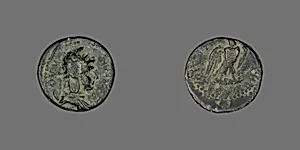
Coin Depicting the Head of a Man
27 BCE-14 CE
Medium
Bronze
Dimensions
Diam.: 1.6 cm (11/16 in.)
Classification
coin
Department
Arts of Greece, Rome, and Byzantium
Museum
Art Institute of Chicago
Accession Number
142939
Rights
Public Domain
About this artwork
The front (obverse) of this coin depicts the head of a man wearing a Phrygian cap, facing to the right. On the back, an eagle stands with wings open.
Art Historical Context
This petite bronze coin, measuring just 1.6 cm in diameter, hails from the early Roman Empire during the reign of Emperor Augustus (27 BCE– CE). Struck in an era when Rome transitioned from republic to empire, it features the profile head of a man—likely an imperial portrait—capturing the refined realism that defined Augustan artistry. Displayed in the Art Institute of Chicago's Department Arts of Greece, Rome, and Byzantium, it exemplifies the everyday yet monumental role of numismatics in ancient life. Roman coins like this were more than currency; they served as tools of propaganda, circulating Augustus' image across the vast empire to foster loyalty and divine authority. Crafted via striking metal blanks between engraved dies, the technique produced intricate details in hair, facial features, and laurel wreaths, blending Greek-inspired portraiture with Roman innovation. Bronze denominations, such as the as, were accessible to common folk, making imperial iconography ubiquitous. Today, this unassuming artifact offers a tangible glimpse into Rome's golden age, where even pocket change embodied political power and cultural identity. Visitors can marvel at its enduring luster, a testament to the artistry that helped shape Western civilization.
About the Artist
Ancient Roman
The artists attributed to "Ancient Roman" in museum collections represent the anonymous craftsmen who produced the vast output of sculpture, frescoes, mosaics, and reliefs defining Roman visual culture from the Republic (c. 509–27 BCE) to the late Empire (c. 395 CE). Individual identities remain elusive, as Roman makers were typically viewed as skilled tradesmen—often enslaved Greeks or provincial...