
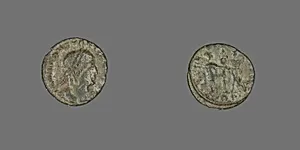
Coin Portraying Emperor Constantius II
335-337
Medium
Bronze
Dimensions
Diam.: 1.5 cm (5/8 in.)
Classification
coin
Department
Arts of Greece, Rome, and Byzantium
Museum
Art Institute of Chicago
Accession Number
143010
Rights
Public Domain
About this artwork
The front (obverse) of this coin portrays the emperor Constantius II. On the back (reverse), two soldiers face each other, holding a standard with drapery between them.
Art Historical Context
This petite bronze coin, struck between 335 and 337 CE, captures the youthful profile of Constantius II, son of Emperor Constantine the Great and future ruler of the Roman Empire from 337 to 361 CE. Measuring just 1.5 cm in diameter, it exemplifies the everyday artistry of ancient Roman mints, where such coins circulated widely as currency, propaganda, and portable symbols of imperial power. Displayed in the Art Institute of Chicago Department of Arts of Greece, Rome, and Byzantium, it offers a tangible glimpse into the late Roman Empire's transition from pagan traditions to emerging Christian influences under Constantine's dynasty. Roman imperial coinage like this was a masterful blend of portraiture and messaging. The obverse likely features Constantius II's idealized laureate head, a convention rooted in Hellenistic influences that conveyed divinity and authority. Crafted via striking hammered dies into bronze flans, these coins balanced mass production with fine detailing—subtle engraving techniques allowed for lifelike features despite the tiny scale. Beyond economics, they propagated the emperor's legitimacy across the vast empire, from Britain to Persia. As numismatic art, this coin highlights Rome's enduring legacy of blending utility with iconography, making grand history accessible in the palm of a hand. A reminder that even small artifacts shaped empires.
About the Artist
Ancient Roman
The artists attributed to "Ancient Roman" in museum collections represent the anonymous craftsmen who produced the vast output of sculpture, frescoes, mosaics, and reliefs defining Roman visual culture from the Republic (c. 509–27 BCE) to the late Empire (c. 395 CE). Individual identities remain elusive, as Roman makers were typically viewed as skilled tradesmen—often enslaved Greeks or provincial...