
Coin Portraying Emperor Emperor Constantine I
307-337
Medium
Bronze
Dimensions
Diam.: 1.9 cm (3/4 in.)
Classification
coin
Department
Arts of Greece, Rome, and Byzantium
Museum
Art Institute of Chicago
Accession Number
142630
Rights
Public Domain
About this artwork
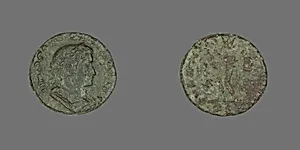
The front (obverse) of this coin portrays the emperor Constantine I, facing right and wearing a crown of laurels. On the back (reverse), the sun deity Sol is depicted standing, wearing a radiate crown and holding a globe in his left hand while rasing his right.
Art Historical Context
This small bronze coin, struck during the reign of Emperor Constantine (r. 306–337 CE), captures the profile of one of Rome's most transformative leaders. Measuring just 1.9 cm in diameter, it the precision of ancient Roman minting techniques, where metal was hammered between engraved dies to create finely detailed portraits. As a product of imperial workshops, such coins were not mere currency but tools of propaganda, circulating Constantine's image across the vast empire to affirm his authority and divine favor. Constantine's era marked a pivotal shift in Roman history, from pagan traditions to Christianity's rise—he famously legalized the faith via the Edict of Milan in 313 CE and convened the Council of Nicaea in 325 CE. Coins like this often featured symbolic motifs, such as laurel wreaths or military attributes, underscoring his role as a warrior-emperor who reunified the fractured empire and founded Constantinople as a new capital. Housed in the Art Institute of Chicago's Department of Arts of Greece, Rome, and Byzantium, this artifact highlights numismatics' value in art history: tiny yet telling, it reveals the artistry and ideology of late antiquity, bridging classical realism with emerging Byzantine styles. A testament to everyday Roman innovation, it invites us to ponder power's portable face.
About the Artist
Ancient Roman
The artists attributed to "Ancient Roman" in museum collections represent the anonymous craftsmen who produced the vast output of sculpture, frescoes, mosaics, and reliefs defining Roman visual culture from the Republic (c. 509–27 BCE) to the late Empire (c. 395 CE). Individual identities remain elusive, as Roman makers were typically viewed as skilled tradesmen—often enslaved Greeks or provincial...