
Coin Portraying Emperor Theodosius
379-395
Medium
Bronze
Dimensions
Diam.: 2.2 cm (7/8 in.)
Classification
coin
Department
Arts of Greece, Rome, and Byzantium
Museum
Art Institute of Chicago
Accession Number
142649
Rights
Public Domain
About this artwork
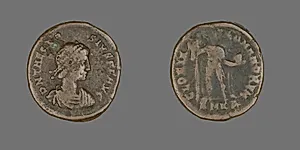
The front (obverse) of this coin portrays emperor Theodosius. The back (reverse) shows Theodosius in military garb looking to his right, holding a standard and a globe.
Art Historical Context
This small bronze coin, struck during the reign of Emperor Theius I (379–395 CE), offers a glimpse into the late Roman Empire's power dynamics. Theodosius, the last emperor to rule both the Eastern and Western of the empire, is depicted in profile—a standard convention in Roman numismatics that conveyed imperial authority and divine favor. Measuring just 2.2 cm in diameter, it served as everyday currency while doubling as propaganda, circulating his image across the vast territories from Britain to the Levant. Crafted through the ancient technique of striking metal blanks between engraved dies, the coin exemplifies Roman minting precision, with fine details in the emperor's laurel-wreathed portrait and likely reverse motifs symbolizing victory or deities. Bronze aes coins like this were accessible to the masses, unlike rarer gold or silver issues, making them vital for trade and daily life. Housed in the Art Institute of Chicago's Department of Arts of Greece, Rome, and Byzantium, this artifact bridges classical Rome and the emerging Byzantine world. Theodosius's era marked Christianity's rise as state religion, and such coins reflect shifting cultural identities amid empire's twilight. A tiny testament to enduring legacy!
About the Artist
Ancient Roman
The artists attributed to "Ancient Roman" in museum collections represent the anonymous craftsmen who produced the vast output of sculpture, frescoes, mosaics, and reliefs defining Roman visual culture from the Republic (c. 509–27 BCE) to the late Empire (c. 395 CE). Individual identities remain elusive, as Roman makers were typically viewed as skilled tradesmen—often enslaved Greeks or provincial...