
Coin Portraying Empress Salonina
264-265
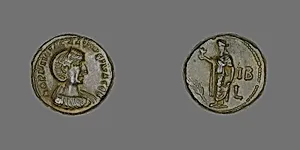
Medium
Billon
Dimensions
Diam.: 2.2 cm (7/8 in.)
Classification
coin
Department
Arts of Greece, Rome, and Byzantium
Museum
Art Institute of Chicago
Accession Number
101116
Rights
Public Domain
About this artwork
The front (obverse) of this coin portrays the empress Salonina, facing right and crowned with a diadem. On the back (reverse) Eirene (personification of peace and the daughter of Zeus and Themis) stands left holding an olive branch. A palm branch appears in the field in front. Salonina was married to the Roman emperor Gallienus, who reigned jointly with his father, Valerian, from 253-260, then as sole emperor to 268. The date this coin was struck is indicated in the reverse inscription "LIB ",...
Art Historical Context
This small billon coin, struck around 264-265 CE during the turbulent Crisis of the Third Century, features a portrait of Empress Julia Cornelia Salonina, wife of Emperor Gallienus Measuring just 2.2 cm in diameter, it Roman imperial coinage from the Art Institute of Chicago's collection of Greek, Roman, and Byzantine. Salonina's elegant profile, likely on the obverse, reflects the refined portraiture style honed over centuries, with intricate engraving capturing her diademed hair and regal features to symbolize imperial authority and continuity. Billon, a debased alloy of silver and base metals, highlights the economic strains of the era—plagues, invasions, and civil wars forced Rome to dilute its currency, making coins like this both practical money and propaganda tools. Distributed across the empire, they promoted the imperial family, fostering loyalty amid chaos. Artistically, the coin's high-relief striking technique showcases Roman minting precision, blending functionality with subtle artistry that influenced later Byzantine numismatics. As a window into a fraying empire, this unassuming artifact reveals how even everyday objects carried profound cultural weight, humanizing distant rulers for soldiers, merchants, and citizens alike.
About the Artist
Ancient Roman
The artists attributed to "Ancient Roman" in museum collections represent the anonymous craftsmen who produced the vast output of sculpture, frescoes, mosaics, and reliefs defining Roman visual culture from the Republic (c. 509–27 BCE) to the late Empire (c. 395 CE). Individual identities remain elusive, as Roman makers were typically viewed as skilled tradesmen—often enslaved Greeks or provincial...