
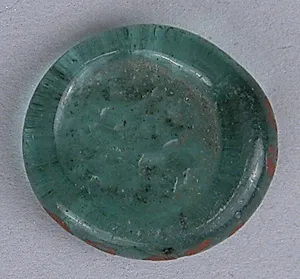
Coin Weight
Unknown Artist
10th–12th century
Medium
Glass
Dimensions
H. 1/8 in. (0.3 cm) Diam. 7/16 in. (1.1 cm) Wt. 0.06 oz. (1.7 g)
Classification
Glass
Department
Islamic Art
Museum
Metropolitan Museum of Art, New York, NY
Credit
Rogers Fund, 1908
Accession Number
08.256.58
Rights
Public Domain
Tags
Art Historical Context
This delicate glass coin weight, dating to the 10th–12th century, the precision craftsmanship of Islamic artisans during a golden age of trade and commerce. Measuring just 1/8 inch high and 7/16 inch in diameter, and weighing a mere 0.06, it was designed to match the exact weight of gold dinars or similar coins circulating in the Abbasid or Fatimid realms. Housed in the Metropolitan Museum of Art's Islamic department (acquired via the Rogers Fund in 1908), it highlights the era's sophisticated systems of weights and measures essential for bustling markets from Baghdad to Cairo. Crafted from glass—a medium prized in Islamic workshops for its translucency and moldability—this tiny disc showcases advanced techniques like molding or casting to achieve uniform density. Unlike metal weights, glass offered corrosion resistance and aesthetic appeal, often inscribed or decorated, though this example's simplicity underscores its practical function. Such tools ensured fair exchange in an economy fueled by silk roads and maritime routes, reflecting Islamic law's emphasis on honest measurement (as in the Quran's calls for just weights). Visitors will appreciate how this unassuming object reveals the ingenuity behind medieval Islamic prosperity, bridging art, science, and daily life in a world of intricate trade networks.