
Coliseum
c. 1867
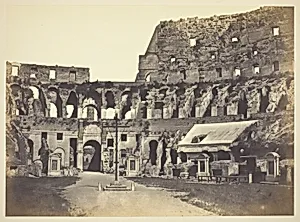
Medium
Albumen print
Dimensions
Image/paper: 30.2 × 41.1 cm (11 15/16 × 16 3/16 in.); Mount: 49 × 64 cm (19 5/16 × 25 1/4 in.)
Classification
albumen silver print
Department
Photography and Media
Museum
Art Institute of Chicago
Accession Number
54469
Rights
Public Domain
Art Historical Context
Step into the majestic ruins of Rome's Colosseum through Robert MacPherson's captivating *Coliseum* (c. 1867), an albumen silver print that freezes the ancient amphitheater's weathered grandeur in exquisite detail. Australian-born photographer Robert MacPherson, who settled in Rome in the 1840s, became renowned for his meticulous documentation of the city's classical antiquities. Working during the height of the Grand Tour era when wealthy Europeans flocked to Italy for cultural inspiration, MacPherson's images offered unprecedented access to these iconic sites, bridging the gap between traveler and armchair explorer. This albumen print—produced by coating paper with egg whites and silver salts on a glass negative—delivers the medium's signature warm tones, sharp clarity, and subtle luminosity, making the Colosseum's arches and eroded stonework leap to life. At 30.2 × 41.1 cm on a larger mount, it invites intimate scrutiny of textures and shadows that evoke the passage of nearly two millennia. MacPherson's straightforward yet atmospheric approach elevated photography from mere reproduction to an artistic medium, influencing 19th-century perceptions of history and decay. Housed in the Art Institute of Chicago's Photography and Media department, this print exemplifies early photographic mastery, reminding us how 1860s innovations democratized the wonders of Rome for global audiences. A timeless portal to antiquity!
About the Artist
Robert MacPherson · 1811–1872
Robert Macpherson (1811–1872) was a Scottish artist who began his career in medicine before pivoting to painting and ultimately pioneering photography in Rome. Born in the Tayside region near Edinburgh, he enrolled at the University of Edinburgh in 1831 to study medicine but left without graduating after four years. He then trained at the Royal Scottish Academy, where he exhibited portraits from 1...