
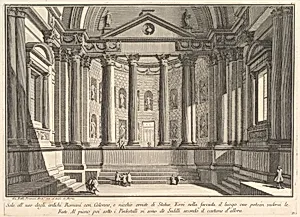
Colonnaded hall according to the custom of the ancient Romans, and niches adorned with statues (Sala all'uso degli antichi Romani con Colonne, e nicchie ornate di Statue), from "Prima Parte di Architettura, e Prospettive"
ca. 1750
Medium
Etching
Dimensions
Plate (Image): 9 5/8 × 14 7/16 in. (24.5 × 36.6 cm) Plate (Inscription): 5/8 × 14 5/16 in. (1.6 × 36.3 cm) Sheet: 13 1/4 × 19 1/2 in. (33.7 × 49.5 cm)
Classification
Prints
Department
Drawings and Prints
Museum
Metropolitan Museum of Art, New York, NY
Credit
Harris Brisbane Dick Fund, 1937
Accession Number
37.45.3(14)
Rights
Public Domain
Tags
Art Historical Context
In the grand tradition of 18th-century Italian vedute—detailed architectural views—Giovanni Battista Piranesi's etching *Colonnaded hall according to the custom of the ancient, and niches adorned with* (ca. 1750) imagines a majestic interior inspired by classical antiquity. Part of his early series *Prima Parte di Architettura, e Prospettive*, this work depicts a vast, colonnaded hall with rhythmic arches, towering columns, and niches filled with heroic statues, evoking the opulence of ancient Roman palaces. Piranesi, a master etcher and visionary architect, blends precise observation with dramatic fantasy, creating spaces that feel both archaeologically authentic and impossibly sublime. Piranesi's etchings were revolutionary for their technical virtuosity: using intricate cross-hatching and deep biting of the copper plate, he achieved rich tonal contrasts and a sense of infinite depth on a modest sheet (13¼ × 19½ in.). Produced during the height of the Grand Tour era, when European elites flocked to Rome, these prints fueled neoclassical fervor, inspiring architects like Robert Adam. This piece, now in the Metropolitan Museum of Art's Drawings and Prints collection (Harris Brisbane Dick Fund, 1937), captures Piranesi's passion for Rome's ruins—celebrating their enduring grandeur while hinting at humanity's fleeting glory. A perfect window into Enlightenment dreams of the past!
About the Artist
Giovanni Battista Piranesi · 1720–1778
Giovanni Battista Piranesi (1720–1778) was an Italian printmaker, architect, and antiquarian whose visionary etchings of Rome and imaginary prisons revolutionized architectural representation and profoundly influenced both Neoclassicism and Romanticism. Piranesi stands as one of the most important printmakers of the eighteenth century, fundamentally shaping European perceptions of ancient Rome an...