
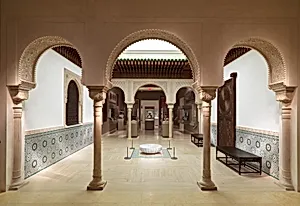
Column
Unknown Artist
1350–1400
Medium
Marble; carved
Dimensions
Base: H. 9 in. (22.9 cm) W. 13 1/2 in. (34.3 cm) D. 13 1/2 in. (34.3 cm) Wt. 95 lbs. (43.1 kg) Column: H. 59 1/2 in. (151.1 cm) Diam. 8 1/4 in. (21 cm) Wt. 196 lbs. (88.9 kg) Capital: H. 13 in. (33 cm) W. 11 7/8 in. (30.2 cm) D. 11 7/8 in. (30.2 cm) Wt. 111 lbs. (50.3 kg) Abacus: H. 4 1/4 in. (10.8 cm) W. 15 in. (38.1 cm) D. 15 in. (38.1 cm) Wt. 80 lbs. (36.3 kg)
Classification
Sculpture
Department
Islamic Art
Museum
Metropolitan Museum of Art, New York, NY
Credit
Gift of The Hearst Foundation, 1956
Accession Number
56.234.21a–d
Rights
Public Domain
Art Historical Context
This intricately carved marble, dating to 1350–1400, stands as a to the architectural splendor of the late medieval Islamic world. Comprising a sturdy base, slender shaft rising to 59½ inches, ornate capital, and broad abacus top, the sculpture weighs nearly 500 pounds in total. Crafted from high-quality marble, it exemplifies precision of stone carving techniques prevalent in Islamic artisans' workshops, where masons skillfully shaped durable stone into elegant supports for mosques, madrasas, or palaces. In the Department of Islamic Art at The Metropolitan Museum of Art—gifted by The Hearst Foundation in 1956—this column reflects the era's emphasis on harmonious proportions and subtle decoration. Such elements were integral to grand architectural ensembles, blending functionality with aesthetic grace. Though the artist remains unknown, the work highlights the anonymous mastery of Islamic sculptors, who prioritized structural integrity and refined detailing over personal fame. Visitors will appreciate how this fragment evokes the lost grandeur of 14th-century Islamic cities, inviting reflection on the enduring legacy of craftsmanship that supported vibrant cultural and religious life.