
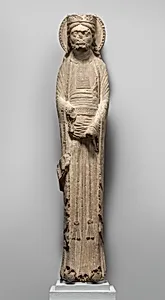
Column Statue of a King
Unknown Artist
ca. 1150–60
Medium
Limestone
Dimensions
45 7/8 × 9 1/4 × 9 1/8 in., 155 lb. (116.5 × 23.5 × 23.2 cm, 70.3 kg) Other (Column without king): 45 7/8 × 5 1/2 in. (116.5 × 14 cm)
Classification
Sculpture-Stone
Culture
French
Department
Medieval Art
Museum
Metropolitan Museum of Art, New York, NY
Credit
Purchase, Joseph Pulitzer Bequest, 1920
Accession Number
20.157
Rights
Public Domain
Tags
Art Historical Context
Step into the majestic world of 12th-century France with this *Column Statue of a King a striking limestone sculpture dating to around 1150–60. Carved from a single block of stone, the figure stands about 3 feet 10 inches tall, weighing a substantial 155 pounds, and depicts a regal male figure—likely representing a biblical or historical king—atop a detachable column shaft. Such architectural sculptures were integral to medieval cathedrals and churches, adorning doorways or columns to convey spiritual and royal authority to worshippers. Crafted during the Romanesque period, just as Gothic innovations emerged, this piece exemplifies the era's emphasis on elongated, dignified forms and intricate stone carving techniques. French sculptors hollowed and polished the limestone to achieve smooth surfaces and expressive details, like flowing robes and a poised stance, symbolizing divine kingship amid the Crusades and feudal power struggles. The statue's separation from its column highlights its modular design, allowing for precise installation in grand portals. Today, this anonymous masterpiece graces the Metropolitan Museum of Art's Medieval Art collection, acquired through the Joseph Pulitzer Bequest in 1920. It invites us to ponder the blend of faith, monarchy, and artistry that defined medieval Europe.