
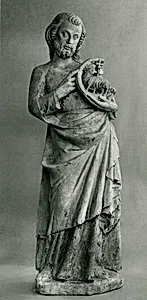
Saint John the Baptist
Unknown Artist
14th century with later recarving
Medium
Limestone
Dimensions
Overall: 64 7/8 x 23 x 11 in. (164.8 x 58.4 x 27.9 cm)
Classification
Sculpture-Stone
Culture
North French
Department
Medieval Art
Museum
Metropolitan Museum of Art, New York, NY
Credit
Gift of J. Pierpont Morgan, 1916
Accession Number
16.32.29
Rights
Public Domain
Tags
Art Historical Context
This striking limestone sculpture of *Saint John the Baptist*, originating from northern France in the 14th century, stands as a testament to medieval devotional art. Carved during the Gothic period, when sculptors adorned cathedrals and churches with saintly figures to inspire faith among pilgrims, this nearly life-sized work (over 5 feet tall) captures the prophet in a moment of prophetic fervor. The inclusion of a sheep—likely symbolizing the Lamb of GodAgnus Dei), a common attribute for John—underscores his role as the forerunner of Christ, preaching repentance in the wilderness. The use of limestone, a favored medium in northern French workshops for its workability and weather resistance, allowed for intricate detailing in drapery and expressive gestures, though later recarving suggests restorations to preserve its form over centuries. Such sculptures were integral to religious life, serving as focal points for prayer and processions in parish churches or abbeys. Generously gifted to the Metropolitan Museum of Art by J. Pierpont Morgan in 1916, this piece now invites visitors to connect with the spiritual intensity of the Middle Ages, where art bridged the earthly and divine.