
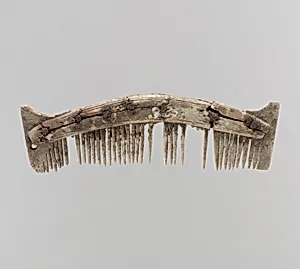
Comb
Unknown Artist
6th century
Medium
Bone, iron pins
Dimensions
Overall: 6 1/2 x 1 3/4 x 11/16 in. (16.5 x 4.5 x 1.7 cm)
Classification
Bone
Culture
Frankish
Department
Medieval Art
Museum
Metropolitan Museum of Art, New York, NY
Credit
Gift of J. Pierpont Morgan, 1917
Accession Number
17.193.123
Rights
Public Domain
Art Historical Context
This delicate bone comb, crafted in the 6th century by an unknown Frankish artisan, a glimpse into everyday life during the early Merovingian period. Measuring just 6½ x 1¾ x 11/16 inches, it features iron pins set into a slender bone handle, a practical design for grooming that reflects the resourcefulness of post-Roman Europe. Bone was a favored medium for such personal items—durable, lightweight, and easily carved—highlighting the skilled bone-working techniques prevalent among the Franks, a Germanic people who established a powerful kingdom in what is now France and Germany. Frankish culture bridged the late Roman world and the Middle Ages, and artifacts like this comb reveal the importance of personal hygiene and adornment even amid turbulent times. Combs were not mere tools but status symbols, often buried with their owners, suggesting they held cultural or even superstitious value. The iron pins add a touch of metallurgy expertise, underscoring the Franks' growing mastery of combined materials. Now housed in the Metropolitan Museum of Art's Medieval Art department—thanks to a 1917 gift from financier J. Pierpont Morgan—this unassuming object connects us to the human stories behind grand historical shifts, reminding visitors of the artistry in the ordinary.