
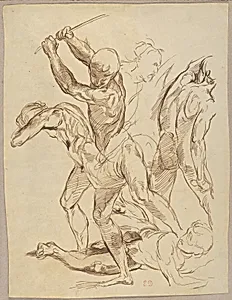
Combat of Nude Men, after Raphael
Medium
Pen and brown ink
Dimensions
Overall: 12 5/8 x 9 7/16 in. (32 x 24 cm)
Classification
Drawings
Department
Drawings and Prints
Museum
Metropolitan Museum of Art, New York, NY
Credit
Gift from the Karen B. Cohen Collection of Eugène Delacroix, in honor of George R. Goldner, 2013
Accession Number
2013.1135.1
Rights
Public Domain
Tags
Art Historical Context
This dynamic pen-and-ink drawing captures Eugène Delacroix’s careful study of Raphael’s Renaissance compositions around 1823. Delacroix, a leading figure of French Romanticism, frequently copied works by earlier masters to explore dramatic movement and the expressive potential of the human body. Here, he renders a fierce battle between nude male figures, emphasizing twisting torsos, straining limbs, and intense physical confrontation that would later inform his own large-scale history paintings. Executed in fluid brown ink on paper measuring roughly 12 by 9 inches, the sheet demonstrates Delacroix’s masterful line work and his interest in classical anatomy. By revisiting Raphael’s idealized forms, the young artist bridged High Renaissance harmony with the emotional intensity of the Romantic era. The drawing thus serves as both homage and creative exercise, revealing how Delacroix absorbed lessons from the past to energize his own revolutionary vision. Housed in the Metropolitan Museum’s collection as part of a generous gift honoring drawings curator George R. Goldner, this work offers visitors a rare glimpse into the preparatory process behind one of the nineteenth century’s most passionate painters.
About the Artist
Eugène Delacroix|Raphael (Raffaello Sanzio or Santi) · 1798–1863
Eugène Delacroix (1798–1863) stands as the defining figure of French Romanticism and a pivotal bridge to modernism. Born in Charenton-Saint-Maurice near Paris, he came from distinguished lineage—his mother descended from the prestigious Oeben-Riesener furniture dynasty, while persistent speculation suggested the statesman Talleyrand may have been his biological father, a theory supported by physic...