
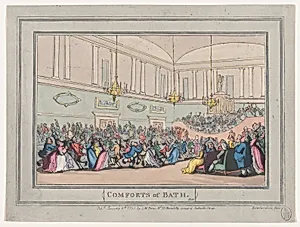
Comforts of Bath, Plate 10
January 6, 1798
Medium
Hand-colored etching and aquatint
Dimensions
Sheet: 7 11/16 × 10 1/4 in. (19.6 × 26 cm)
Classification
Prints
Department
Drawings and Prints
Museum
Metropolitan Museum of Art, New York, NY
Credit
The Elisha Whittelsey Collection, The Elisha Whittelsey Fund, 1959
Accession Number
59.533.558(10)
Rights
Public Domain
Tags
Art Historical Context
In the lively satire *Comforts of Bath, 10* (1798), British caricaturist Thomas Rowlandson, published by S. W. Fores, captures the boisterous social scene of Bath, England's famed spa resort. This hand-colored etching and aquat depicts a crowded dance floor teeming with men and women Regency-era finery, their exaggerated poses conveying chaotic revelry amid the "comforts" fashionable leisure. Part of Rowlandson's series poking fun at's elite visitors—who flocked there for therapeutic waters, gambling, and flirtations—this plate humorously exposes the overcrowding and indecorous behavior beneath the veneer of gentility. Rowlandson's mastery of caricature shines through the medium: etching provides crisp, satirical lines for expressive figures, while aquatint adds tonal depth to suggest bustling energy. Hand-coloring enhances the vividness, a popular technique for affordable prints that brought elite satire to a wider audience. Created during the late Georgian era, when Bath symbolized health and high society, the work reflects cultural shifts toward urban pleasure-seeking and critiques social excesses. Today, housed in the Metropolitan Museum of Art's Elisha Whittelsey Collection, this print exemplifies Rowlandson's enduring legacy in British graphic art, blending sharp wit with technical innovation to entertain and provoke. (198 words)
About the Artist
Thomas Rowlandson|S. W. Fores · 1756–1827
Thomas Rowlandson (1757–1827) was an English artist and caricaturist whose satirical watercolors and prints captured the social life of Georgian Britain with unparalleled wit and technical mastery. Alongside James Gillray, he is recognized as one of the greatest British graphic artists, and his distinctive flowing line and keen observations have made his work integral to understanding late 18th an...