
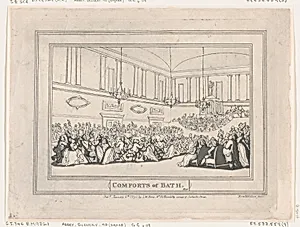
Comforts of Bath, Plate 10
January 6, 1798
Medium
Etching
Dimensions
Sheet: 8 11/16 × 11 1/4 in. (22.1 × 28.6 cm) Plate: 7 11/16 × 10 1/4 in. (19.6 × 26 cm)
Classification
Prints
Department
Drawings and Prints
Museum
Metropolitan Museum of Art, New York, NY
Credit
The Elisha Whittelsey Collection, The Elisha Whittelsey Fund, 1959
Accession Number
59.533.559(9)
Rights
Public Domain
Tags
Art Historical Context
Thomas Rowlandson's *Comforts of Bath, Plate 10* (1798) captures the lively chaos of Regency-era social life in Bath, England's premier spa town. This etching, part of a satirical series poking fun at the town's fashionable visitors, depicts a crowded scene teeming with men, women spectators, dancers, and revelers. Rowlandson, a master caricaturist known for his exaggerated figures and witty commentary on British society, highlights the pretensions and indulgences of the upper classes amid Bath's therapeutic baths and assembly rooms. Created through etching—a printmaking technique using acid to bite intricate lines into a metal plate—Rowlandson's work allowed for sharp details and tonal shading that amplified the humor. The modest plate size (7 11/16 × 10 1/4 in.) made it affordable for a wide audience, disseminating satire via hand-colored impressions popular in late 18th-century London. Housed in the Metropolitan Museum of Art's Elisha Whittelsey Collection, this print reflects Bath's cultural zenith as a hub for courtship, gossip, and leisure. Rowlandson's gleeful mockery endures as a window into the era's social follies, reminding us how art can both entertain and critique.
About the Artist
Thomas Rowlandson · 1756–1827
Thomas Rowlandson (1757–1827) was an English artist and caricaturist whose satirical watercolors and prints captured the social life of Georgian Britain with unparalleled wit and technical mastery. Alongside James Gillray, he is recognized as one of the greatest British graphic artists, and his distinctive flowing line and keen observations have made his work integral to understanding late 18th an...