
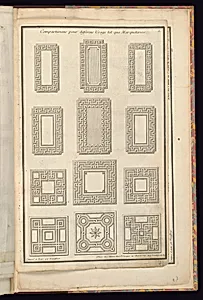
Compartimens pour differens Usage tel que Marqueteries
Medium
Classification
Department
Smithsonian Collection
Museum
Smithsonian American Art Museum
Credit
Purchased for the Museum by the Advisory Council
Accession Number
1921-6-371-26
Rights
Public Domain
About this artwork
Research in Progress
Art Historical Context
**Compartimens pour differens Usage que Marqueteries** *Jean-François de Neufforge (Flemish, 1714–1791), 1763* Etching or engraving on paper Created in 1763 by Flemish artist and designer Jean-François de Neuff, this print belongs to the Smithsonian American Art's collection of decorative arts, purchased by the Advisory Council. The, translating to "Compartments for Uses Such as Marquetry," suggests a practical pattern book plate featuring geometric or ornamental divisions adaptable for woodworking, inlays, or furniture decoration. Neufforge, active during the Rococo-to-Neoclassical transition, specialized in architectural engravings that bridged fine art and craft. In the 18th century, prints like this were vital tools for disseminating precise designs across Europe, enabling artisans from Paris workshops to Flemish cabinetmakers to replicate intricate motifs without direct patronage. Marquetry, the technique of veneering woods in contrasting colors, flourished in this era's opulent interiors, reflecting Enlightenment-era fascination with symmetry and utility. Though research on this specific sheet is ongoing, it exemplifies how printed media democratized high-style decoration. Today, it invites visitors to appreciate the fusion of artistry and functionality, underscoring European influences on global design traditions preserved in American collections. (198 words)