
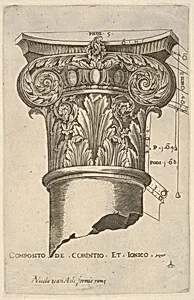
Composite capital with measurements
ca. 1530–1540
Medium
Engraving
Dimensions
Sheet: 8 13/16 x 5 11/16 in. (22.4 x 14.5 cm) Mount: 10 11/16 x 6 7/16 in. (27.2 x 16.3 cm)
Classification
Prints|Ornament & Architecture
Department
Drawings and Prints
Museum
Metropolitan Museum of Art, New York, NY
Credit
Bequest of Phyllis Massar, 2011
Accession Number
2012.136.823
Rights
Public Domain
Tags
Art Historical Context
This delicate engraving, titled *Composite Capital with Measurements*, comes from the workshop of the enigmatic Monogrammist G. & the Caltrop, active around 1530–1540. Rendered on a modest sheet measuring 8 13/16 x 5 11/16 inches, it showcases a richly ornamented architectural capital—a composite blending Ionic volutes and Corinthian acanthus leaves. Such designs reflect the Renaissance fascination with classical antiquity, revived through rediscovered Roman treatises like Vitruvius's *De Architectura*. As an engraving, a precise intaglio technique where lines are incised into a metal plate, this print exemplifies the era's innovative printmaking boom in Northern Europe. Artists like the Monogrammist produced these "pattern books" to disseminate architectural motifs to builders, sculptors, and designers across Europe, standardizing ornamental vocabulary amid the Gothic-to-Renaissance transition. The inclusion of precise measurements underscores its practical utility, bridging art and engineering. Housed in the Metropolitan Museum of Art's Drawings and Prints department through the generous bequest of Phyllis Massar in 2011, this work highlights how prints democratized elite design knowledge, influencing cathedrals, palaces, and furnishings for centuries. A testament to 16th-century ingenuity!
About the Artist
Monogrammist G.A. & the Caltrop · 1535–1535
**Monogrammist G.A. with the Caltrop**, an enigmatic Italian engraver active in Rome during the 1530s and 1540s, remains one of the shadowy figures of the Renaissance print world. Identified solely by his monogram "G.A." accompanied by a distinctive caltrop symbol—a spiked iron ball used in warfare—little is known of his personal life or training. His early years are not well documented, and no te...