
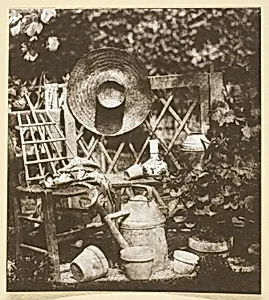
Composition au chapeau
c. 1842, printed 1965
Medium
Gelatin silver print, No. 7 from the portfolio "Bayard: XXV Calotypes, 1842-1850" (1965)
Dimensions
Image/paper/mount: 19.6 × 17.6 cm (7 3/4 × 6 15/16 in.)
Classification
photographic process
Department
Photography and Media
Museum
Art Institute of Chicago
Accession Number
23765
Rights
Public Domain
Art Historical Context
Hippolyte Bayard stands among the earliest pioneers of photography, creating this delicate still-life composition around 1842, just a few years after the medium’s public announcement. Working in France alongside contemporaries like Louis Daguerre and William Henry Fox Talbot, Bayard his own direct-positive process on paper. “Composition au chapeau” showcases his inventive approach to everyday objects—in this case, a hat—into carefully balanced scenes that explore light, texture, and form. Printed in 1965 as part of the portfolio “Bayard: XXV Calotypes, 1842–1850,” this gelatin silver print allows modern viewers to appreciate Bayard’s original calotype negative. The calotype process, which permitted multiple prints from a single negative, offered greater flexibility than the unique daguerreotype and helped lay the groundwork for photography’s future as both an art and a reproducible medium. Measuring just under eight inches square, the intimate scale invites close looking, revealing Bayard’s sensitivity to tonal gradation and spatial arrangement. Today it resides in the Art Institute of Chicago’s Photography and Media department, reminding visitors of photography’s rapid evolution from experimental curiosity to recognized artistic practice.
About the Artist
Hippolyte Bayard · 1801–1887
Hippolyte Bayard (1801–1887) was a French civil servant and artist who holds a remarkable, if bittersweet, place in the history of photography: he was one of the independent inventors of the photographic process in the late 1830s, developing his own direct positive paper print method at virtually the same moment that Louis Daguerre and William Henry Fox Talbot were arriving at their own solutions ...