
Composition de F. Millet (Composition by F. Millet)
in or before 1869
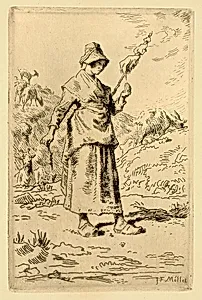
Medium
etching in black on laid paper (facing _Composition de F. Millet_ by Albert Merat)
Dimensions
plate: 19.9 x 13 cm (7 13/16 x 5 1/8 in.) page size: 35.5 x 25.5 cm (14 x 10 1/16 in.)
Classification
Department
CG-E
Museum
National Gallery of Art, Washington, D.C.
Credit
Gift of Richard A. Simms, in Honor of the 50th Anniversary of the National Gallery of Art
Accession Number
1991.26.1.cc
Rights
Public Domain
Art Historical Context
Jean-François Millet, a leading figure of the French Realist movement and the Barbizon school, created this intimate etching in or before 1869. Known for his dignified portrayals of rural life and peasant labor, Millet here demonstrates his mastery of printmaking. The work appears as a paired composition opposite a poem by Albert Merat, suggesting its original context within a literary or artistic publication that blended image and verse. Executed in black etching on laid paper, the print measures just under eight inches in height, showcasing the medium’s ability to capture delicate lines and tonal depth with remarkable economy. Etching allowed Millet to reach wider audiences than his paintings, and this example reflects the growing appreciation for original prints in the nineteenth century. Its modest scale and refined technique invite close viewing, revealing the artist’s careful attention to composition and texture. Now part of the National Gallery of Art’s collection through a generous gift, the etching stands as a testament to Millet’s enduring influence on both painting and graphic art. It offers visitors a glimpse into the artist’s later explorations of print media and his commitment to celebrating everyday subjects with quiet poetry.
About the Artist
Jean-François Millet · 1814–1875
Jean-François Millet (1814-1875) was a French painter and one of the founders of the Barbizon school, whose dignified depictions of peasant laborers transformed how art could represent rural life. His monumental images of sowers, gleaners, and field workers elevated common people to subjects previously reserved for mythological or historical figures, making him a pivotal figure in the development ...