
Compote
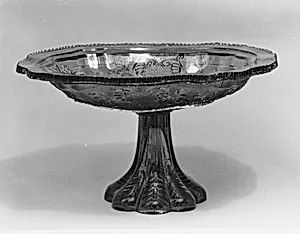
Medium
Lacy pressed glass
Dimensions
6 1/16 x 10 5/8 x 8 15/16 in. (15.4 x 27 x 22.7 cm)
Classification
Compote
Culture
American
Department
The American Wing
Museum
Metropolitan Museum of Art, New York, NY
Credit
Bequest of Anna G. W. Green, in memory of her husband, Dr. Charles W. Green, 1957
Accession Number
57.131.14
Rights
Public Domain
Art Historical Context
This elegant compote, crafted by the Boston & Sandwich Glass Company between 1830 and 1850, exemplifies the golden age of American pressed glass production. Nestled in the Metropolitan Museum of Art's American Wing, this footed serving dish—measuring 6 1/16 x 10 5/8 x 8 15/16 inches—was designed for displaying fruits or desserts on Victorian tabletops. Donated through the bequest of Anna G. W. Green in memory of her husband, Dr. Charles W. Green, it reflects the era's blend of industrial innovation and refined domestic taste. The standout feature is its "lacy pressed glass" medium, a technique pioneered in the 1820s where molten glass was pressed into intricately patterned molds, creating delicate, lace-like motifs without the labor-intensive cutting of pricier European glass. Boston & Sandwich, based in Massachusetts, was a leader in this affordable luxury, producing wares that democratized ornamentation for America's growing middle class. This method allowed for mass production of complex designs, symbolizing the young nation's manufacturing prowess during the Industrial Revolution. As a cultural artifact, the compote highlights 19th-century American ingenuity, bridging handmade craftsmanship and machine efficiency. Its geometric or floral patterns (typical of the style) evoke the period's fascination with neoclassical elegance, making it a charming window into everyday opulence. Visitors will appreciate how such pieces furnished homes with both beauty and utility.
About the Artist
Boston & Sandwich Glass Company · 1825–1888
The Boston & Sandwich Glass Company, a pioneering force in American glassmaking, was established in 1825 in Sandwich, Massachusetts, by visionary entrepreneur Deming Jarves, who had honed his expertise as an agent for the New England Glass Company in Cambridge. Jarves built the factory on the banks of the Cape Cod Canal, incorporating it formally the following year with Boston investors. Drawing o...