
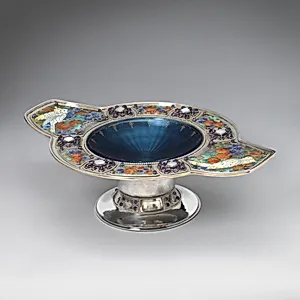
Compote
ca. 1900
Medium
Silver, gold wire, enamel, amethyst, moonstone2
Dimensions
Overall (confirmed): 5 1/16 × 16 5/8 × 11 5/8 in. (12.9 × 42.2 × 29.5 cm)
Classification
Metalwork-Silver
Culture
Norwegian, Oslo
Department
European Sculpture and Decorative Arts
Museum
Metropolitan Museum of Art, New York, NY
Credit
Gift of Jacqueline Loewe Fowler, 2020
Accession Number
2021.7.1
Rights
Public Domain
Tags
Art Historical Context
This elegant compote, created around 1900 by the Norwegian firm David-Andersen in Oslo, exemplifies the refined silverwork traditions of Scandinavia at the turn of the twentieth century. Crafted from silver with intricate gold wire, enamel, amethyst, and moonstone, the piece serves as both a functional fruit dish and a luxurious decorative object. Its modest yet graceful scale—roughly five inches high and over sixteen inches wide—highlights the meticulous craftsmanship typical of Norwegian metalworkers, who blended utility with ornamental beauty during a period of growing national artistic identity. The inclusion of bird motifs, as noted in the museum’s tags, adds a lively, naturalistic touch that elevates the compote beyond everyday tableware. Enamel and gemstone inlays would have required skilled techniques to achieve vibrant color and texture against the silver surface, reflecting the high standards of David Andersen’s workshop, which supplied both domestic and international patrons. Acquired by the Metropolitan Museum through a generous gift in 2020, this work offers visitors a window into early modern European decorative arts, where everyday objects became canvases for artistic expression.
About the Artist
David-Andersen|David Andersen (Norwegian|Norwegian) · 1876 |1843 –2099 |1901
Norwegian, 1876–present|Norwegian, 1843–1901