
Concordantzen alt und news Testaments
Medium
etching
Dimensions
114; 142
Rights
Public Domain
About this artwork
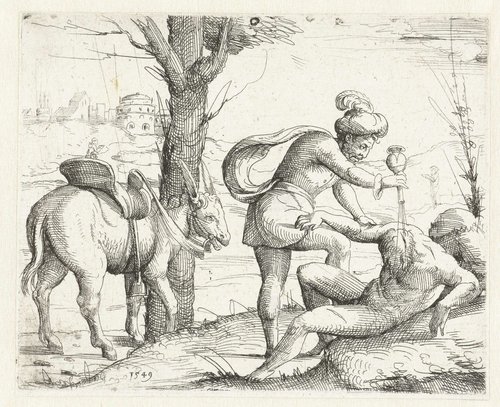
Een Samaritaan helpt onderweg een gewonde reiziger door hem te wassen.
Art Historical Context
Augustin Hirschvogel, a versatile German Renaissance artist (1503–1555), *Concordantzen alt news Testaments* in1549 as a delicate etching measuring just 114 × 142 mm. Trained as a glass painter and mathematician, Hirschvogel excelled in printmaking, producing intricate works that bridged art and devotion during the Protestant Reformation. This small-scale etching reflects the era's growing demand for affordable religious imagery, allowing biblical narratives to reach households beyond grand altarpieces. The scene depicts a pivotal moment from the New Testament parable of the Good Samaritan (Luke 10:30–37), where a compassionate Samaritan aids a wounded traveler by washing his wounds along the roadside. The title, meaning "Concordances of the Old and New Testaments," suggests this print is part of a series harmonizing biblical stories, emphasizing moral lessons of mercy and neighborly love—timely themes amid 16th-century religious upheavals. Hirschvogel's etching technique shines here: using a needle to incise fine lines into a metal plate, he achieved precise, expressive details in the figures' gestures and landscape, evoking empathy in viewers. Such prints were revolutionary for their reproducibility, making profound Christian teachings accessible to everyday people and underscoring the cultural power of visual storytelling in Reformation Europe.
About the Artist
Augustin Hirschvogel · 1503–1553
Augustin Hirschvogel (1503–1553) was born in Nuremberg into a prominent family of stained-glass painters who dominated the city's glass workshops during the late 15th and early 16th centuries. The son of Veit Hirschvogel the Elder (1461–1525), Nuremberg's official glazier who executed designs after Albrecht Dürer and Hans von Kulmbach, Augustin trained as a glass painter in his father's workshop. ...