
Conestoga Wagon Jack
1935/1942
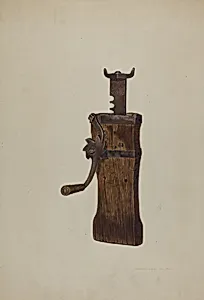
Medium
watercolor, graphite, and pen and ink on paperboard
Dimensions
overall: 35.5 x 23.6 cm (14 x 9 5/16 in.)
Classification
Index of American Design
Department
CG-W
Museum
National Gallery of Art, Washington, D.C.
Credit
Index of American Design
Accession Number
1943.8.3712
Rights
Public Domain
Art Historical Context
Behold the *Conestoga Wagon Jack by Edward L. Loper, a captivating 1935/1942 watercolor, graphite, and pen-and-ink rendering on paperboard, measuring a modest 35.5 x 23.6 cm. This depiction captures a sturdy wooden jack used to lift the iconic Conestoga wagonsthose legendary vehicles that carried pioneers westward across America's rugged frontiers in the 18th and 19th centuries Loper's precise lines and vibrant washes bring to life the tool's functional beauty: its geared mechanism, sturdy levers, and weathered patina evoking the grit of pioneer life. Created as part of the Index of American Design, a Federal Art Project under the Works Progress Administration (WPA) from 1935 to 1942, this work exemplifies a national effort to document and celebrate everyday American folk objects. Artists like Loper meticulously recorded artifacts that embodied the nation's cultural heritage, preserving them through art during the Great Depression. Housed in the National Gallery of Art, it highlights the ingenuity of colonial craftsmen who engineered such durable devices for overland travel. The mixed media—watercolor for rich tones, graphite for subtle shading, and ink for sharp outlines—lends a timeless quality, blending realism with artistic flair. This piece invites us to appreciate not just a humble tool, but a symbol of American resilience and innovation, reminding visitors of the unsung heroes who built a nation on wheels.
About the Artist
Edward L. Loper · 1916–2011
Edward Leroy Loper Sr. was born on April 7, 1916, in Wilmington, Delaware, to a poor family in the racially mixed Frogtown neighborhood, where he was raised primarily by his maternal grandmother. After graduating from Howard High School, the only secondary school available to African Americans in Delaware at the time, Loper received no formal artistic training initially but immersed himself in sel...