
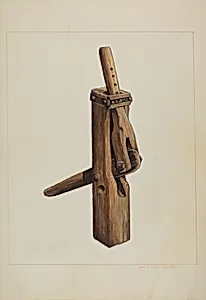
Wagon Jack
1935/1942
Medium
watercolor, graphite, colored pencil, and gouache on paperboard
Dimensions
overall: 35.2 x 24.3 cm (13 7/8 x 9 9/16 in.)
Classification
Index of American Design
Department
CG-W
Museum
National Gallery of Art, Washington, D.C.
Credit
Index of American Design
Accession Number
1943.8.11922
Rights
Public Domain
Art Historical Context
**Wagon Jack** by Samuel W. Ford, between 1935 and1942, is a mixed-media rendering on paperboard, blending watercolor, graphite, colored pencil, and gouache. 35.2 x 24.3 cm, this work captures the sturdy form of a traditional "wagon jack"—a clever wooden tool used by American farmers and wagon makers to lift heavy vehicles for repairs. Ford's precise lines and rich colors highlight the object's folk craftsmanship, from its carved handle to its mechanical ratchet, evoking the ingenuity of everyday rural life. As part of the *Index of American Design*, a landmark WPA Federal Art Project from the Great Depression era, this piece served a vital preservation mission. Artists like Ford meticulously documented vanishing American folk arts, creating over 15,000 renderings to celebrate the nation's cultural heritage. Housed in the National Gallery of Art's CG-W department, it reflects how New Deal programs employed thousands of artists while safeguarding regional traditions against modernization. Ford's technique—layering translucent watercolors with opaque gouache for depth and graphite for fine details—brings the humble wagon jack to life, transforming a utilitarian object into a symbol of American resilience and creativity. Visitors will appreciate how this artwork bridges art, history, and hands-on innovation from the heartland.