
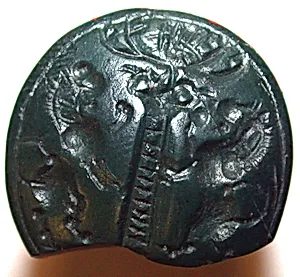
Conical seal
Unknown Artist
ca. 6th century BCE (?)
Medium
Jasper, dark green
Dimensions
H. 1 1/16 in. (2.7 cm); Diam. 1/2 in. (1.2 cm)
Classification
Stone-Stamp Seals
Culture & Period
Achaemenid · Achaemenid
Department
Ancient Near Eastern Art
Museum
Metropolitan Museum of Art, New York, NY
Credit
Gift of Nanette B. Kelekian, in memory of Charles Dikran and Beatrice Kelekian, 1999
Accession Number
1999.325.115
Rights
Public Domain
Tags
Art Historical Context
This exquisite conical seal, crafted from dark green jasper around the 6th century BCE,ails from the Achaemenid Empire—the vast Persian realm that stretched from India to Egypt under rulers like Cyrus the Great and Darius I. Measuring just over an inch tall and half an inch wide, its petite size belies its profound role in ancient administration. Achaemenid stone-stamp seals like this one were essential tools for imprinting soft clay on documents, packages, or doors, serving as personal signatures of ownership, authority, or identity in a sprawling bureaucracy. Carved in intaglio (incised in reverse for stamping), the seal likely features lions, majestic symbols of royal power and protection in Achaemenid art. Jasper's hardness and vibrant hue made it ideal for durable, finely detailed engraving, showcasing the empire's masterful lapidary techniques. These seals bridged art and daily life, reflecting a culture where iconography reinforced imperial might amid conquests and cultural fusion. Today, this gift to the Metropolitan Museum of Art evokes the ingenuity of ancient Persia, inviting us to ponder the hands that rolled it across clay over 2,500 years ago.