
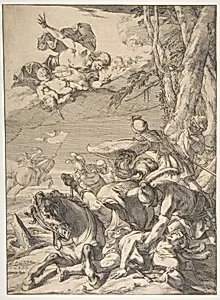
Conversion of St. Paul
Medium
Engraving
Classification
Prints
Department
Drawings and Prints
Museum
Metropolitan Museum of Art, New York, NY
Credit
The Elisha Whittelsey Collection, The Elisha Whittelsey Fund, 1956
Accession Number
56.644.10
Rights
Public Domain
Tags
Art Historical Context
In the Prints collection of the Metropolitan Museum of, Laurent de La Hy's *Conversion of St. Paul* captures a pivotal biblical moment from the Acts of the Apostles. The engraving depicts Saul of Tarsus—later Saint Paul—struck blind by a divine light on the road to Damascus, tumbling from his horse amid startled soldiers. This dramatic scene, rich with horses, men in armor, and the saint in a moment of revelation, embodies the transformative power of faith, a popular theme in 17th-century religious art. Laurent de La Hyre, a prominent French artist of the Baroque era (1606–1656), blended classical restraint with emotional intensity, bridging the exuberant Baroque style and the emerging French Classicism. Though the exact date is unknown, his engravings like this one showcase his mastery of line and composition, designed for wide dissemination through printmaking. Engraving, a meticulous intaglio technique where lines are incised into a metal plate, allowed detailed imagery to be reproduced affordably, making sacred narratives accessible to devotees beyond elite patrons. Acquired through The Elisha Whittelsey Collection in 1956, this work highlights the cultural role of prints in spreading Counter-Reformation iconography, inviting viewers to reflect on personal conversion amid the era's religious fervor. A testament to La Hyre's skill, it draws us into the chaos and awe of divine intervention.
About the Artist
Laurent de La Hyre · 1606–1656
Laurent de La Hyre (1606–1656) was a French painter whose elegant, classical compositions placed him among the finest artists of the first generation of French Baroque painters working in Paris. Born into an artistic family — his father Étienne de La Hyre was also a painter — Laurent received his early training largely through independent study rather than formal apprenticeship under a single domi...