
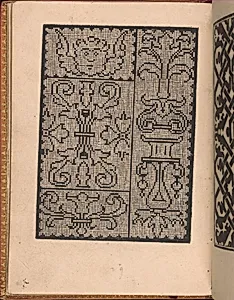
Convivio delle Belle Donne, page 19 (verso)
August 1532
Medium
Woodcut
Dimensions
Overall: 7 7/8 x 5 1/2 in. (20 x 14 cm)
Classification
Books|Prints|Ornament & Architecture
Department
Drawings and Prints
Museum
Metropolitan Museum of Art, New York, NY
Credit
Rogers Fund, 1922
Accession Number
22.66.6(37)
Rights
Public Domain
Tags
Art Historical Context
Step into the whimsical world of Renaissance ornamentation with *Convivio delle Belle Donne, page 19 (verso)*, a delicate woodcut created in August 1532 by the Venetian collaborators Nicolò Zoppino and Matteo da Treviso. Produced during the height of Italy's printing boom, this page hails from a book likely celebrating beauty and festivity—its title evoking a "Banquet of Beautiful Women." Measuring just 7 7/8 x 5 1/2 inches, it exemplifies the intimate scale of early printed books, now treasured in the Metropolitan Museum of Art's Drawings and Prints department. Crafted as a woodcut—a relief printing technique where intricate designs are carved into wood blocks and inked for multiple impressions—this artwork showcases Matteo da Treviso's skillful rendering of flowing vines, blooming flowers, and elegant vases. These motifs were staples of Renaissance decorative arts, influencing architecture, textiles, and furniture design. Woodcuts like this democratized ornate patterns, making high-style embellishments accessible beyond elite workshops. As part of the Rogers Fund acquisition of 1922, this print highlights the era's fusion of artistry and innovation, bridging books, prints, and ornamental traditions. Visitors will appreciate its timeless charm, a snapshot of 16th-century Venice's vibrant print culture.
About the Artist
Nicolò Zoppino|Matteo da Treviso · 1478–1544
Nicolò Zoppino was an Italian printer and publisher active in Venice and other Italian cities during the first half of the sixteenth century, occupying an important place in the history of early printing and book illustration. Born around 1478, he worked during the golden age of Venetian printing, a period when the city was the dominant center of book production in Europe and publishers competed t...