
Convivio delle Belle Donne, page 20 (recto)
August 1532
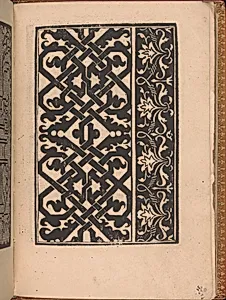
Medium
Woodcut
Dimensions
Overall: 7 7/8 x 5 1/2 in. (20 x 14 cm)
Classification
Books|Prints|Ornament & Architecture
Department
Drawings and Prints
Museum
Metropolitan Museum of Art, New York, NY
Credit
Rogers Fund, 1922
Accession Number
22.66.6(38)
Rights
Public Domain
Tags
Art Historical Context
Step into the vibrant world of Renaissance Venice with *Convivio delle Belle Donne, 20 (recto)*, a delicate woodcut created in August 1532 by the Nicolò Zoppino and Matteo da Treviso. just 7 7/8 x 5 1/2 inches, this page hails from a book blending beauty and ornamentation, its intricate designs of flowing vines and blooming flowers evoking the era's fascination with nature's elegance. Acquired through the Rogers Fund in 1922, it now graces the Metropolitan Museum of Art's Drawings and Prints department. Woodcuts like this were revolutionary in the 16th century, allowing for affordable mass production of detailed illustrations in books. Zoppino, a prolific Venetian publisher, collaborated with da Treviso to craft these patterns, classified under Ornament & Architecture, ideal for inspiring textile designs, embroidery, or architectural motifs. The title, meaning "Banquet of Beautiful Women," hints at a celebratory theme, where floral vines likely frame scenes of grace and festivity, reflecting Italy's Renaissance revival of classical harmony and botanical motifs. This artwork captures the cultural bloom of the period, when printed books democratized artistic inspiration for artisans and designers across Europe, bridging fine art and everyday craft.
About the Artist
Nicolò Zoppino|Matteo da Treviso · 1478–1544
Nicolò Zoppino was an Italian printer and publisher active in Venice and other Italian cities during the first half of the sixteenth century, occupying an important place in the history of early printing and book illustration. Born around 1478, he worked during the golden age of Venetian printing, a period when the city was the dominant center of book production in Europe and publishers competed t...