
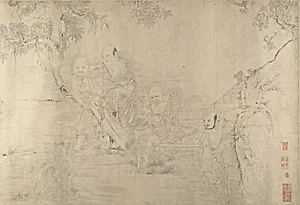
清 佚名 倣石濤 十六羅漢圖 卷|(Copy after) The Sixteen Luohans
19th–early 20th century
Medium
Handscroll; ink on paper
Dimensions
19 5/8 in. × 20 ft. 9 3/4 in. (49.8 × 634.4 cm)
Classification
Paintings
Culture & Period
China · Qing dynasty (1644–1911)
Department
Asian Art
Museum
Metropolitan Museum of Art, New York, NY
Credit
John Stewart Kennedy Fund, 1913
Accession Number
13.220.37a, b
Rights
Public Domain
Tags
Art Historical Context
This handscroll, created by an anonymous artist in the late Qing dynasty, offers a reverent reinterpretation of Shitao’s (Zhu Ruoji, 1642–1707) celebrated depiction of the Sixteen Luohans. Shitao, a former Buddhist monk and leading individualist painter, infused his works with expressive brushwork and spiritual depth. Though dated to the 19th–early 20th century, the painting captures the essence of Shitao’s dynamic ink techniques—fluid lines and varying washes—that bring the enlightened arhats to life as they meditate, converse, and traverse ethereal landscapes. Luohans, revered in Buddhism as guardians of the faith and exemplars of enlightenment, embody ideals of wisdom and compassion central to Chinese religious art. The handscroll format invites intimate viewing, unrolling gradually to reveal a continuous narrative across nearly 21 feet of paper. Acquired by the Metropolitan Museum in 1913, this copy reflects the enduring admiration for Shitao’s innovative style during the Qing era, when artists frequently emulated earlier masters to preserve and reinterpret cultural heritage. The work’s ink-on-paper medium highlights traditional Chinese painting’s emphasis on spontaneity and inner expression over literal representation.