
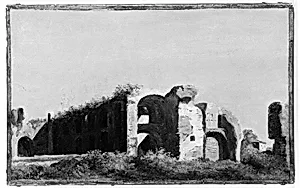
Copy after Valenciennes's "Ruins at the Villa Farnese"
before 1819
Medium
Oil on paper, laid down on canvas
Dimensions
9 1/4 x 15 1/4 in. (23.5 x 38.7 cm)
Classification
Drawings
Department
European Paintings
Museum
Metropolitan Museum of Art, New York, NY
Credit
Harry G. Sperling Fund, 1978
Accession Number
1978.48.2
Rights
Public Domain
Tags
Art Historical Context
This exquisite copy after Pierre-Henri deiennes's *Ruins at the Villaese* captures the timeless allure of ancient Roman architecture, featuring weathered arches and crumbling ruins bathed in soft light. Created by an anonymous French painter 1819, it evokes the neoclassical fascination with antiquity during the Napoleonic era, when artists flocked to Rome to study classical remnants like those at the Villa Farnese the Capitoline Hill. Valenciennes (1750–1819), a pioneering French landscape painter, championed plein-air sketching and atmospheric effects, influencing Romanticism and early Impressionism. Copies such as this one—likely made by a student or admirer—helped disseminate his techniques amid the vibrant artist communities in Rome, preserving the emotional resonance of ruins as symbols of fleeting glory and human endurance. Rendered in oil on paper laid down on canvas, this intimate 9¼ × 15¼-inch work blurs the line between drawing and painting, highlighting the era's innovative use of portable media for on-site studies. Acquired through the Harry G. Sperling Fund in 1978, it resides in the Metropolitan Museum of Art's European Paintings department, classified as a drawing—a testament to its preparatory, sketch-like vitality.
About the Artist
French Painter
"French Painter" is a scholarly attribution designation used by art historians and museum curators to catalogue paintings produced in France — or by artists trained in the French tradition — when the specific creator cannot be identified with confidence. Rather than leave a work without provenance context or assign it speculatively to a named artist, curators apply this designation alongside an ap...