
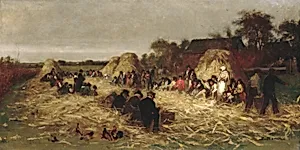
Corn Husking at Nantucket
ca. 1875
Medium
Oil on canvas
Dimensions
27 5/8 x 54 1/2 in. (70.2 x 138.4 cm)
Classification
Painting
Culture
American
Department
The American Wing
Museum
Metropolitan Museum of Art, New York, NY
Credit
Rogers Fund, 1907
Accession Number
07.68
Rights
Public Domain
Tags
Art Historical Context
Eastman Johnson's *Corn Husking at Nant* (ca. 1875) captures a lively communal gathering on the Massachusetts island famed for its whaling heritage. This large-scale oil on canvas (27 5/8 x 54 1/2 in.) depicts a crowd engaged in the fall tradition of corn husking—a social event blending labor and festivity in 19th-century rural New England. Johnson's keen eye for everyday American life transforms this genre scene into a vibrant tableau of community bonds, with figures animated in shared purpose under open skies. As a master of American Realism, Johnson elevated ordinary moments to celebrate national identity in the post-Civil War era. His meticulous oil technique—rich in texture and warm earth tones—brings depth to the expansive composition, emphasizing human connection amid agricultural rhythms. Housed in The Metropolitan Museum of Art's American Wing, this Rogers Fund acquisition (1907) highlights the cultural shift toward romanticizing agrarian roots as industrialization loomed. Fun fact: Nantucket's isolation fostered tight-knit traditions like husking bees, where neighbors competed playfully to find the lucky red ear of corn, symbolizing romance. Johnson's work invites viewers to savor these vanishing rituals.
About the Artist
Eastman Johnson · 1824–1906
Eastman Johnson (1824–1906) was an American painter known as "the American Rembrandt" for his richly toned genre paintings and portraits that constitute one of the most important visual records of nineteenth-century American life. Born in Lovell, Maine, he trained in Düsseldorf, The Hague — where he studied the Dutch Old Masters extensively — and Paris before returning to the United States. Johns...