
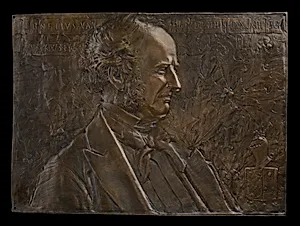
Cornelius Vanderbilt I
Medium
Bronze
Dimensions
16 1/4 × 22 3/4 in. (41.3 × 57.8 cm)
Classification
Relief
Culture
American
Department
The American Wing
Museum
Metropolitan Museum of Art, New York, NY
Credit
Purchase, Brooke Russell Astor Bequest and David Schwartz Foundation Inc. Gift, 2016
Accession Number
2016.71
Rights
Public Domain
Tags
Art Historical Context
Behold the striking bronze relief *Cornelius Vanderbilt I* (1882) by Augustus Saint-Gaud, a master of American sculpture during the Gilded Age. 16¼ × 22¾ inches, this profile portrait captures the formidable visage of the railroad tycoon known as the "Commod," whose empire reshaped transportation and commerce in 19th-century America.-Gaudens, renowned his Beaux-Arts precision and lifelike realism, crafted this work shortly after Vanderbilt's death in 1877, likely as a commemorative piece honoring his legacy of wealth and innovation. Vanderbilt rose from humble ferry operator to one of the richest men in U.S. history, amassing a fortune through steamboats and railroads that fueled the nation's industrial boom. Displayed in The Metropolitan Museum of Art's American Wing, this artwork reflects the era's fascination with industrial titans, blending portraiture with monumental ambition. The bronze medium—cast for its enduring patina and tactile depth—elevates the relief's subtle modeling, where light and shadow animate Vanderbilt's stern profile, evoking classical medallions while grounding it in modern American identity. Saint-Gaudens's technique here showcases his skill in capturing character through contour and texture, making Vanderbilt not just a face, but a symbol of Gilded Age power. A testament to artistic patronage, it was acquired through generous gifts, inviting visitors to ponder the man behind the myth.
About the Artist
Augustus Saint-Gaudens · 1848–1907
Augustus Saint-Gaudens (1848–1907) was an Irish-born American sculptor widely regarded as the greatest American sculptor of the nineteenth century. Born in Dublin to a French father and Irish mother, he was brought to New York City as an infant. He trained as a cameo cutter, studied at the Cooper Union and the National Academy of Design, and then traveled to Paris, where he studied at the École de...