
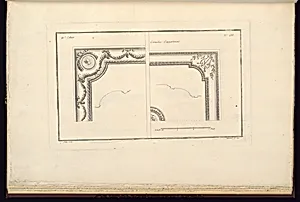
Corniches d'appartement
Medium
Classification
Department
Smithsonian Collection
Museum
Smithsonian American Art Museum
Credit
Purchased for the Museum by the Advisory Council
Accession Number
1921-6-254-42
Rights
Public Domain
About this artwork
Research in Progress
Art Historical Context
**Corniches d'appartement***Juste-François Boucher, French 1736–1782, ca. 1775* *Print; Smithsonian American Art Museum* e-François Boucher, of the renowned Rococo master François Boucher, was a skilled French engraver active during the elegant twilight of the Ancien Régime. Created around 1775, *Corniches d'appartement—translating to "Apartmentices"—likely showcases intricate designs for architectural moldings, those decorative shelf-like elements crowning walls in grand interiors. As a print, it exemplifies the era's printmaking prowess, where fine lines and meticulous shading captured opulent details for replication in homes and salons. In late 18th-century France, such prints were vital tools for architects, designers, and affluent patrons amid the shift from lavish Rococo curves to emerging Neoclassical restraint. Boucher's work would have disseminated sophisticated ornamental motifs, making high-style decoration accessible beyond Versailles. This piece highlights engraving's role in democratizing art and design, bridging fine arts with everyday luxury. Acquired for the Smithsonian American Art Museum through the Advisory Council, it invites us to appreciate how prints preserved the grandeur of French interiors, offering a window into the refined tastes of pre-Revolutionary Europe. Though research continues, its presence underscores the enduring allure of 18th-century decorative innovation.